
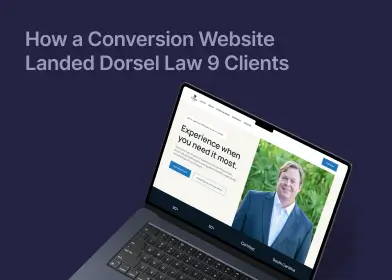
Project Snapshot
Dorsel Law partnered with LegalPeel to transform its website into a conversion-focused digital platform. By combining strategic web design, SEO, and lead generation, the project was designed to attract the right prospective clients and turn website visitors into consultations.
About Dorsel Law and Website Design Project
So, our client Chris Dorsel practiced for over 20 years as a solo personal injury attorney in South Carolina. He had already referred clients for decades. Now he came to us just to leverage the digital era.
Like, really, his referral gets dropped down, as 60% of our clients made this the primary reason why they need a fast-developed law firm website.
So, what Chris Dorsel's proposal for a simple attorney website includes:
- Legal website design with SEO optimization
- Local SEO+ practice area pages
- Basic lead generation setup
Check out the portfolio of the Dorsel law firm.
The Challenge
1. Already a big competitive market for PI firms in South Carolina
From the very first time we checked the client's competitors in the personal injury market in South Carolina, it felt overcrowded. So many reputable firms have high-authority ranking websites on Google and business directories.
2. Local SEO optimization seems hard
So, obviously, we check whether keyword difficulty is lower or not. Surprisingly, the keyword difficulty is moderate (40-60), and that's what is the ultimate challenge for SEO optimization of solo attorney websites.
3. Need to start from scratch with UX mapping and psychology
We need to understand the target audience, their search intent, concerns, and decision-making process before structuring the website. The UX needs to guide potential clients from finding the firm to trusting the attorney and taking action.
4. Need fast launch and clear deliverables
The website needs to launch quickly, so we need to prioritize the most important pages, UX elements, SEO foundations, and conversion points without overcomplicating the initial build.
The Strategy
1. Strategy & Positioning
Since the market is already competitive, we first need to build a USP (Unique Selling Point) and maintain UX psychology.
The biggest win was that most PI firms have outdated websites that are made with templates.
So, we focus on modern tech legal websites that are built for the legal profession, trust, and recognition, rather than template-based websites everywhere.
2. UX & Conversion Strategy
So, we need to map the entire user journey before designing the pages.
We need to understand what potential clients are looking for, what builds trust, and what information they need before contacting an attorney.
The website should guide users naturally from finding the firm to taking action.
3. SEO Strategy
Since the client is competing with established websites, SEO needs to be considered from the beginning rather than added after the website is launched.
We need to focus on realistic practice-area and location-based keywords. Then, we need to build the right on-page, internal linking, and technical SEO foundation.
4. Lead Generation
We need to strategically place consultation opportunities, contact forms, phone CTAs, and other conversion points throughout the user journey.
Without planning a conversion funnel and lead capture tactics, an attorney website can't perform what it needs to
What We Achieve
- We delivered an SEO-optimized law firm website without any technical issues.
- The client approved the website at first glance. No revision need
- Website builder and hosting; website ownership fully given to the client.
- Overall, Client Chris's kind words and satisfaction
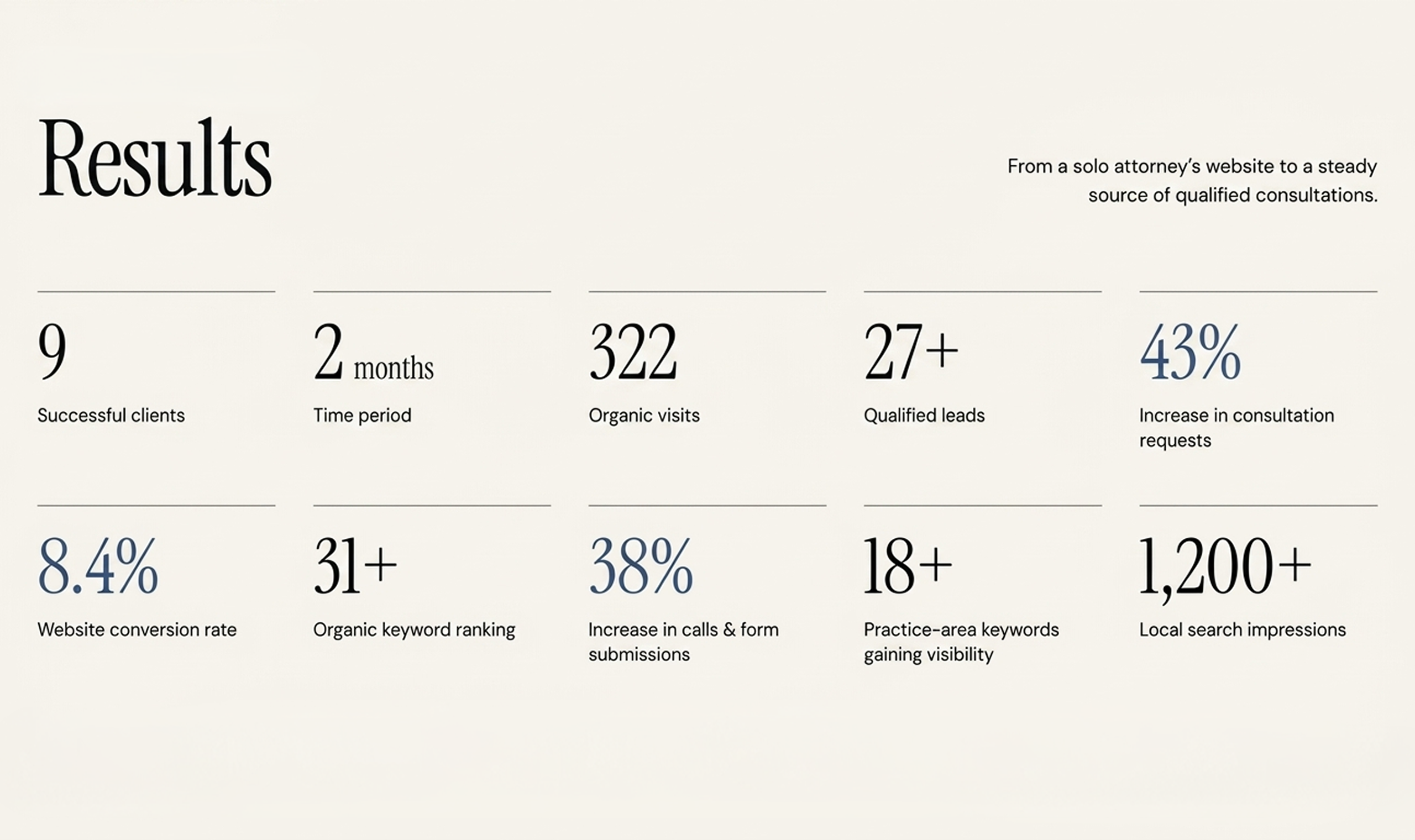
Result
The result isn’t luck. It’s the outcome of an optimized, conversion-focused law firm website that’s working now and built to keep working.
See the numbers. And count yours.
Client Feedback
I was impressed with the thoroughness of the website and the copy that was created based on my answers to questions.
–Chris Dorsel, Founder, Dorsel Law
.webp)
When choosing a law firm web design agency, evaluate experience with law firms, legal SEO optimization, lead generation and accessibility setup, fair pricing, and detailed milestones with a timeline breakdown.
So, you don't have to research a thousand times to choose the right one. Use this as a checklist and choose a web design partner without confusion or frustration.
7 Things to Look for in a US-Based Law Firm Web Design Agency
1. Experience With Law Firms
Hiring a general design agency vs a law firm web design agency makes a huge difference.
Designing a law firm site needs a completely different angle, like highlighting lawyers' credibility, maintaining accessibility and compliance, appointment form integration, case management software, and so on.
So, asking for previous work with a is an essential step before hiring.
2. Works with your firm size and practice area
You’ll never believe it, but yeah, you should do the hard work here. Before you move on to the next agency, make sure to take a look if they work with small or solo law firms like you.
Most solo and small firms make massive mistakes with it. Partnering with a reputable firm that works for mid-to-large law firms and has a top-tier pricing range. Meanwhile, you as a solo attorney get high pricing quotes or complex website-building features that you don't want to or to have.
Get inspiration with the best solo attorney website design examples.
3. Understanding of Legal SEO
So, you don't want to integrate SEO! As you have a referral network and you just want to build a simple website without investing much.
Wait! You need to think again! Launching your new law firm website with SEO isn’t a waste; it’s an investment that returns with great ROI.
So, get what you need to have! Local SEO optimized practice area pages, GMB profile setup and basic technical SEO setup.
4. Conversion-Focused Web Design
Your website shouldn't just look pretty to visit and take over and over. Law firm website design strategy should work on getting clients—a clear statement.
So, check out the attorney web design agency's portfolio to see how they work on website conversion. Like, how they design and place call-to-action buttons and contact forms, and where they locate credentials like awards and reviews so clients can trust easily and just tap a call to you.
5. Website Platform and Ownership
You have already researched the best website builder for a law firm, but does your website design company work with that? Big question here.
So, yeah! You can choose either WordPress, Webflow, Squarespace, or Wix…. It's up to you, but for sure ask for a breakdown of all the domain, hosting, and setup costs and then ownership. No compromise on it.
At LegalPeel, we sign an NDA before any contract and document ownership in it.
Don’t know whether WordPress or Webflow is better? Read our guide on WordPress vs Webflow.
6. Compliance and Legal Website Requirements
Law firm websites have additional considerations that a general business website may not.
Ask the agency how they approach accessibility, ADA compliance, privacy and security setup, state bar requirements, etc.
Your attorney website design shouldn't have thousands of features. But still, it needs to follow legal compliance before it's launched.
The general website agency is lacking here most of the time. So, don't go for cheap quotes.
7. Pricing and What's Included
You're looking for full website design and SEO packages or just a design project?
Define your budget and what your agency is going to be quoted for. And ask what the cost will be. Like, law firm website design cost, development cost, hosting and SEO setup cost, and copywriting cost.
So, you shouldn't be surprised by the extra hidden costs from the agency.
Checking pricing and deliverables is a must-have step.
8. Communication and Project Timeline
Mismanagement can often lengthen the design project and deliveries.
Ask whether they use project management tools like Slack, ClickUp, or Jira for clear milestones, deliverables and open communication.
Again, ask about the milestone timeline properly so you can launch your sites without extra cost and time.
Questions to Ask Before Hiring a Law Firm Web Design Agency
How many law firms have you worked with?
The very first question to justify their experience with a law firm website.
Don't see their project work on the website. There may be many template-based works there. You should ask for the real client website live review link.
Do you provide legal SEO?
Another question to ensure the SEO setup criteria. Ask whether they know how to optimize local practice area pages and bring local traffic to your site.
Who owns the website?
The most important deal you need to do. Ask first whether they hand over all the website ownership or just make you into a vendor contract.
What is included in the quoted price?
Ask for a detailed pricing quote breakdown in a document. Otherwise, you will end up with high, surprising costs.
Do you provide ongoing maintenance?
Clearly ask if they run monthly maintenance for technical issues, technical SEO setup and bug fixes. It'll definitely help you calculate monthly investment.
Can you show relevant case studies?
Ask for the real number results case study from them. Not a good design always justifies it.
You should examine whether they make a conversion-focused website and bring clients in return. Or is it all just in vain?
[[inner-cta]]
How Much Does a Law Firm Web Design Agency Cost?
A law firm web design agency costs between $3,000 and $20,000 depending on your firm size, number of pages, functionality, complexity, website builder, hosting, and maintenance.
Your basic attorney website cost should be $2,500–$5,000. Additional setup, integration, and functionality can increase cost.
Well, a boutique law firm website design agency can quote between $3,000– $6,000 for a solo and small law firm website.
Again, an enterprise agency can cost anywhere between $10,000–$50,000 for legal website design and development.
Final Checklist Before Hiring
- Relevant legal portfolio
- SEO strategy
- Conversion-focused design
- Transparent pricing
- Clear timeline
- Website ownership
- Maintenance/support
- Accessibility and security
Conclusion
Choosing a law firm web design agency from hundreds of options is a big task. You have to investigate multiple things at a time.
But you can make it easy with making a list of how much you can bear, a similar website sample that you want to inspire, no of website pages, and any other criteria you want.
It'll make things better for you and the selected agency to work on the right track with the right cost.
Overall, deciding on an agency is your turn! If you don't have the energy to research more, you can have a short session with LegalPeel.
You may get better web design with SEO and lead generation in mind. Who knows? Let's build your dreamy site today.
[[last-cta]]

Creating a website for a solo practitioner or small law firm can feel overwhelming. Choosing among DIY website builders, hosting providers, and security requirements can be confusing—especially when you’re working within a limited budget.
Popular law firm website builders include Webflow, WordPress, Squarespace, Wix, LawLytics, and Clio Grow. Platforms like Webflow allow lawyers to build websites with hosting, security, and SEO features built in, making them practical for solo and small firms.
In this guide, you’ll get a clear roadmap for building a law firm website on an affordable budget, including the right web builder, hosting provider, security setup, and overall cost considerations.
Best Website Builder for Law Firm: Quick Overview
1. Webflow
%20(2).jpg)
Webflow is the best website builder for law firms because of its easy-to-edit CMS flexibility, fast law firm website developmentenhanced security, a library of thousands of templates, and SEO and AEO features.
Webflow is now the #2 website builder after WordPress, driven by its expanding feature set, lighter plugin architecture, and stronger SEO controls.
Webflow pricing is $14–$39 per month, including a custom domain, hosting, and security, making it budget-friendly for solo and small firms.
You can build a law firm website in Webflow, even without any coding experience. Webflow is a no-code platform with a legal website template collection to help create professional-looking websites.
Note: At LegalPeel, we design custom solo and small firm websites in Webflow. Approximately 60% of our clients switch from WordPress to Webflow for better security, speed, and lower maintenance costs.
2. WordPress
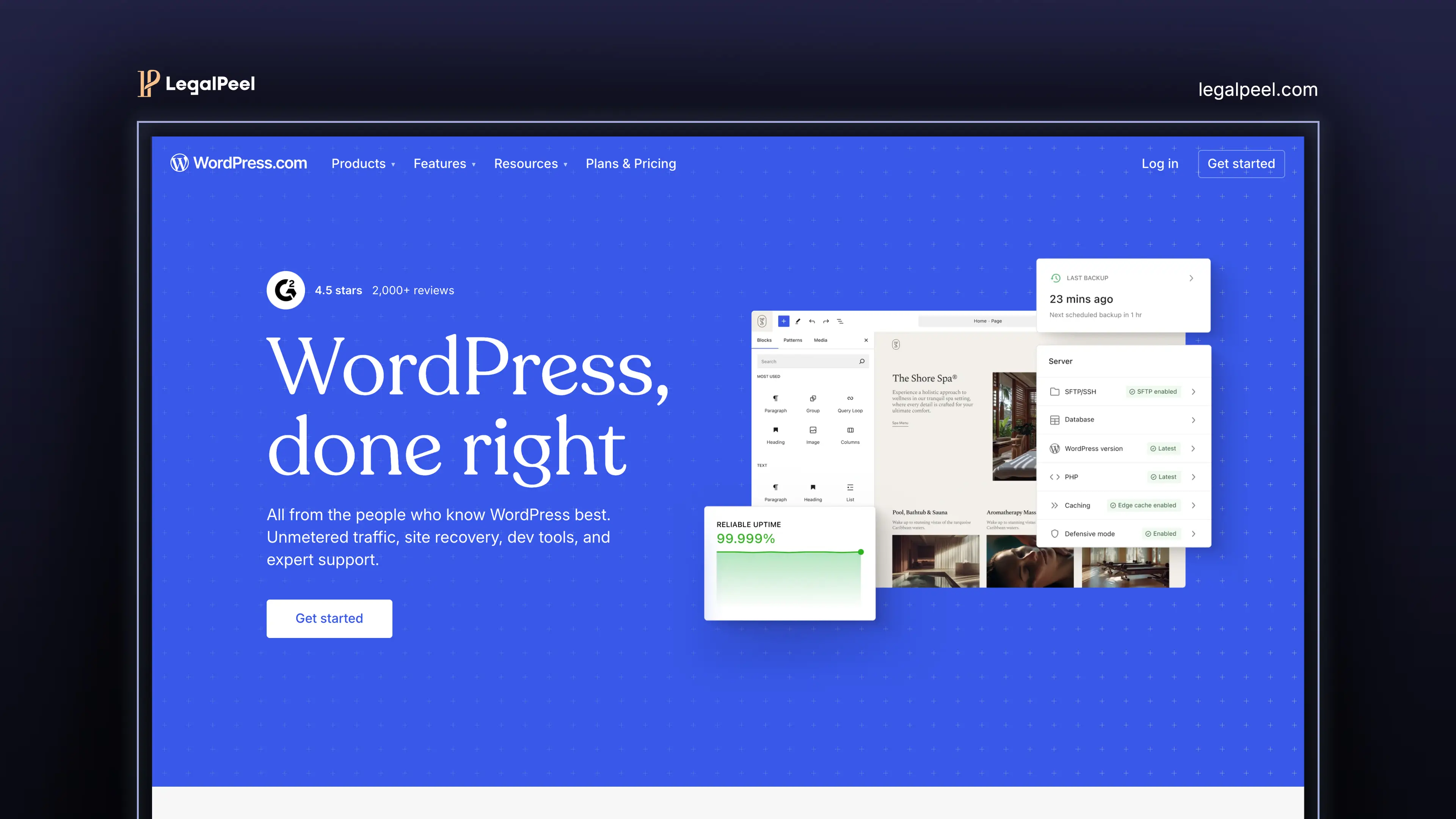
WordPress is the most familiar lawyer website builder and CMS for its content-heavy platform, better SEO, ease for non-tech users, and professional sites.
The WordPress website platform costs around $4–$40 per month. But setting up WordPress hosting, security, plugin costs, and monthly maintenance isn't included in that.
WordPress is well-suited for small and midsize law firms seeking scalable and user-friendly law firm website builders with SEO.
Most solo and small law firms face budget constraints. If you don't want to invest in additional maintenance costs, separate hosting providers, or plugin vulnerabilities, Webflow, Wix, or Squarespace is the best overall choice.
Read out our recent journal WordPress vs. Webflow for law firms
3. Wix

Wix is a user-friendly, flexible attorney website builder that most solo practitioners prefer.
Solo attorneys or boutique law firms can create a simple layout and a generic website using Wix's drag-and-drop builder.
The Wix platform costs $14- $25 per month, making it very affordable for solo lawyers.
But here's one thing to note: Wix isn't well-suited for SEO-optimized, CMS-heavy websites like Webflow or WordPress.
However, solo practitioners and small firms that want a one-page website or a general website with a light CMS can use Wix.
4. Squarespace
%20(1).jpg)
Squarespace is another popular legal website builder known for its clean design templates and easy editing experience.
It is suitable for solo attorneys and small law firms seeking a visually appealing website without the complexity of a technical setup.
Squarespace pricing typically ranges from $16 to $36 per month, including hosting and security.
While Squarespace offers beautiful design templates, its SEO flexibility and CMS capabilities are more limited than those of Webflow or WordPress.
For lawyers who prioritize simple design and ease of use over advanced customization, Squarespace remains a viable option.
So, planning to create a small law firm website? Check out the essential features of a small law firm website design.
5. Clio Grow

Clio Grow is a legal management software that also offers basic website-building features using templates.
It allows lawyers to quickly set up a law firm website with built-in appointment booking, intake forms, and document management features to help capture and manage legal leads.
However, the platform offers a limited number of templates, which can make it difficult to create a highly professional or unique website compared with competitors.
Still, Clio Grow is a convenient option for attorneys who want to launch a simple law firm website quickly with essential features and minimal technical effort.
Worried about website design cost? Estimate your cost properly with the law firm web design and SEO package guide.
6. LawLytics
%20(1).jpg)
LawLytics is a law firm website builder that holds a strong position in serving law firm websites with excellent customer support.
The platform enables law firms to quickly build and launch websites while keeping them easy to manage.
Many attorneys appreciate LawLytics for its responsive customer support, which makes the process smoother for busy lawyers.
However, in some cases, LawLytics websites may lack advanced SEO features compared to more customizable platforms.
Lawyers and attorneys who want to launch a simple, affordable law firm website without additional integrations, advanced lead-generation systems, or extensive SEO optimization may find LawLytics a suitable option.
Law Firm Website Hosting: What Lawyers Must Know
Before locking in a hosting provider, it’s important to understand how hosting can impact your law firm website’s search visibility, lead capture, performance, and security.
Why Hosting Impacts SEO, Security, and Site Speed
Web hosting for lawyers directly impacts SEO and search engine ranking. If your site's hosting server is slow or unreliable, your site will never appear at the top of search results.
Google prioritizes sites that provide a faster, user-friendly experience when visitors land on a website.
Again, law firm websites often handle sensitive information from consultation forms to client inquiries. That’s why website hosting security for a law firm is critical.
A secure hosting environment protects your site from data breaches, malware, and hacking attempts that could damage your reputation and client trust.
Webflow: Best Website Builder + Web Hosting for Law Firms
Webflow combines web design, CMS, hosting, and security into a single platform.
Instead of managing multiple tools, law firms can build and maintain their entire website in a single system, making it a practical solution for law firm web hosting.
Webflow eliminates monthly law firm website hosting and maintenance fees. It's a huge win for solo and small law firms.
Built-In Hosting and Performance: Webflow includes fully managed hosting powered by global cloud infrastructure. This helps ensure fast loading speeds, reliable uptime, and simple website management—making it a dependable option for modern web hosting for law firms.
Security and Cloud Infrastructure: Webflow provides built-in protections, including SSL encryption, DDoS protection, and automatic updates. Its cloud infrastructure also improves reliability and performance, underscoring the importance of secure hosting for law firm websites and making it a strong choice for law firm cloud hosting.
DIY vs Custom Law Firm Website Development
When setting up an attorney website, you may be confused about the difference between a DIY platform and custom website development. Let's bring in a clear decision.
DIY Lawyer Website Building
Building your law firm website may seem easy, but it's not.
Select a template and publish a few pages using the Clio, Lawlytics, or Wix platform. But there are many more factors involved that require time, technical setup, and ongoing maintenance. As a solo lawyer, you may become frustrated at some point while building your solo law firm website.
Pros
- Lower upfront cost
- Faster initial setup using templates
- Full control over edits and updates.
- Suitable for very small firms or new practices
Cons
- Limited design flexibility
- Plugin compatibility issues
- Time-consuming learning curve
- Security and maintenance responsibilities
- Harder to build a high-converting legal website
Custom Law Firm Website Development
Custom law firm web development is a better choice for building a high-performing legal website that supports a strong online presence, lead capture, and SEO visibility.
What exactly is custom web development?
Hire a law firm website design service that will design your website using your brand colors, custom CMS fields, and conversion-focused layouts.
Benefits of Hiring a Law Firm Website Design Agency
- Custom design tailored to your practice area and brand
- SEO-optimized structure for higher visibility in search results
- Conversion-focused layouts designed to generate consultations
- Legal compliance considerations for disclaimers and content structure
- Technical performance optimization for speed and security
- Ongoing support and marketing strategy
[[inner-cta]]
Cost to Build a Law Firm Website in 2026
Depending on your firm's size, practice areas, design complexity, and platform and hosting selection, the cost to build a law firm website varies.
Law firm website design costs typically range from $3,000 to $7,000 for solo and small law firms.
The ongoing cost typically ranges from $50 to $500 for hosting, security, maintenance, and SEO.
Learn more: Understanding attorney website costs with startup and monthly breakdowns.
Build Your Law Firm Website with LegalPeel
You've searched through resources and communities but still can't decide how to build your law firm website on a tight budget.
It may be time to pause the search for a while.
We've already designed and developed 30+ custom Webflow websites for solo practitioners and small law firms. Without vendor lock-in, hidden costs, or delays, we set up your legal website and launch it without technical issues.
And the extras? We structure the Webflow CMS for busy lawyers and non-technical marketing teams. You can update resources, blog posts, or landing page designs without writing any code.
Get your affordable law firm website design package today!
[[last-cta]]
.jpg)
Starting a new law firm often raises the big question: how much does a law firm website design costs?
You already have a quote for a professional site for $1,000. Others charge $20,000+ for custom builds.
So, what’s fair? And how do you avoid overpaying while still getting a website that attracts clients?
In this guide, we’ll break down the real law firm website design cost in 2026, not with guesswork, only with proven estimation and pricing.
How Much Should Law Firm Website Really Cost?
Law firm websites can cost between $3,000 and $20,000 for website design. Additionally, it'll add an extra $50-$100 for hosting and maintenance.
Typically, most decent designers charge $3,000-$5,000 for theme- or template-based law firm websites.
A content-heavy law firm website design will cost around $7,000-$15,000.
Well, there's no exact price range for a lawyer's website. Depending on the number of pages, features, complexity, custom design, SEO emphasis, and CRM integration, an attorney's website cost can be less or more expensive.
What is a Fair Price for Law Firm Website Design?
Everything is going to be overwhelming, right?
Because the question is, what is considered a fair price, overpriced, or underrated? And how to know which law firm website design price aligns with your goals and budget! Here's a common query law firm owners may admire to ask:
Can I start with a basic website and add more features later?
Yes, even starting with a basic website and redesigning the law firm website later is a clever strategy for a budget-friendly website option.
How much should a solo attorney's website cost?
Solo law firms typically have budget constraints and even need to invest in marketing! So, solo attorney website pricing should be under $3,000 –$7,000 for a 10-12 page website. Obviously, you should focus on local SEO optimization to dominate the local area.
What to expect for a lawyer website design cost without SEO?
Well, attorney web design costs around $2,000–$6,000 without SEO emphasis.
Even ignoring SEO, you can design a website, and it's still what many lawyers do!
But the con is that you are left behind the scenes when your competitors are booking the client; you should be.
What is the cost of a multi-attorney website?
It should cost around $15,000-$20,000 to design a content-heavy law firm website. As many pages need to be built in SEO. And law firm website with CRM integration and strong branding is a must-have feature in a multi-attorney website.
Can I get a professional law firm website on a $1,000 Budget?
You'll get a law firm website, but not professionally at this low budget. By using the template and theme, it is possible.
But it would not yet drive value for the future.
Many designers give promises to design a professional website with strong SEO for under $1,000. Don't jump to this cheap quote. Stay alert and know the value first.
How Do You Know If You’re Overpaying for Your Website?
Website bundle package, full digital Service, long-term contract are the signals you may be overpaying or trapped in a long-term cost to build a law firm website. Here's a breakdown:
Paying for unnecessary SEO or extras
Some agencies push SEO retainers, social media management, or PPC bundled into your website project.
As solo practitioners, boutique litigation law firms don't need to invest more in marketing alone. So, if you don’t need them yet, that's a wasted budget.
You can go with law firm websites and SEO bundle packages that save cost. know what it cost with our recent guide.
Lack of a law firm portfolio
Check for their previous portfolio of legal websites. There are many things you need to ensure while designing a lawyer's website. So, it’s essential to hire a law firm web designer.
Otherwise, you'll pay for a high-converting website but be fooled out with a simple showcase.
Limited flexibility for future updates
If every small change requires a fee or developer intervention, your long-term costs will balloon.
Unclear proposals or hidden fees
Terms like "full digital package" or "surprise costs for revisions" often mean you’ll spend more than expected.
Common Red Flags in Designer Quotes
Unclear timelines: 3–6 months without milestones often means delays and more invoices.
No breakdown of costs: An unclear cost measurement without law firm website development, hosting fees, and maintenance assumes you’re overpaying.
No customize quote : $7,000 standard package without customization for your practice area usually signals inflated pricing.
Common Hidden Costs in Law Firm Website Projects
Extra pages: Additional practice area pages you ask for can add more web design costs.
Hosting and domain: Domain registration, hosting, SSL and professional email are costs that are sometimes hidden in quotes.
Third-party tools: CRM, scheduling, forms, and chat software may need subscription fees.
Website maintenance: Your law firm website may need ongoing updates, content changes, technical fixes, and maintenance, which can come with additional costs.
SEO and migration: SEO setup, URL redirects, content migration, and preserving existing search rankings can add extra costs when redesigning or moving your website.
Cost-Saving Strategies for Attorney Website
Instead of overspending upfront, law firms can build smarter. Here's how to save thousands of dollars and crack the marketing floor!
1. Start with a basic website
Most affordable law firm website isn't about cheap template-based options.
You can begin with a strong home page, attorney profiles, and practice area pages. Add integration, chatbots and a dedicated blog page later.
2. Use semi-custom templates initially
Law firm website templates can look premium if they're slightly customized with your brand colors and tone.
Full custom law firm website is obviously costly, but if where redesign is open and wouldn't harm SEO, you should go for a semi-custom website.
3. Separate design from optional SEO
SEO isn't optional at all. You must have built a law firm website with local search engine optimization initially. Get your website live first, then invest in SEO when your firm is ready.
4. Consider boutique/specialized law firm designers
They know your industry and often deliver more value for the cost.
5. Use temporary stock photography
Replace with professional branding photos once your firm grows.
Budget-Friendly Law Firm Website Approach
- Basic website: $2,000–$2,500
- Add-ons: $500–$1,000
- Maintenance: $50–$100/month
- Optional SEO later: $500–$1,000
[[inner-cta]]
Should I Hire A Freelancer or an Agency for Law Firm Website Design?
You should hire freelancers for their low budget, one-to-one communication, more personalized options, and one-time payment options.
On the other hand, hiring a law firm web design agency is worthwhile when you are looking for a professional website, need value over budget, and need scalability.
Freelance law firm web designer
Average Cost: $1,000-$5,000
What to expect:
- Affordable law firm website
- Flexible pricing
- One-time payment
- Smooth communication
Cons:
- Limited Scalability
- Long-term cost burden
- Poor legal functions and integration
Law firm website design agency
Average Cost: $3,500-$20,000
What to expect:
- Branded law firm website
- Best SEO built in
- Fastest delivery
- More customization options
- Integrate legal intake and forms
Cons
- Long-term contract
- Often high pricing
Get a Website Design Cost Estimation
Paying too little usually means you’ll outgrow your site quickly. Paying too much often means being locked into unnecessary bundles or contracts.
The most important things to remember: Don't forget to ensure full ownership and control of your website.
The next move?
You are open to having a transparent law firm website design cost estimation, including ongoing monthly cost, maintenance, web hosting fees, and SEO.
Know what you need and what to avoid! How? Just Request a Custom Quote Now.
[[last-cta]]
.jpg)
Worried about getting a professional small law firm website design within budget constraints, limited resources, and credibility issues?
If you want to outrank established law firms, you should have a credible law firm website as a foundational weapon.
How? Every solo law firm website should include features like a portfolio, a fully responsive design, and streamlined attorney web design elements that highlight your expertise.
Stop working with frustration or delays! Know how to design a website for a small law firm within your budget in this entire guide.
Why Small Law Firm Website Design Matters in 2026
You’ve decided to go solo or run a small law firm with just a few attorneys. Now, instead of relying only on word-of-mouth referrals, you want to build a strong online presence.
Why? For client acquisition and high-value cases.
That’s exactly where a boutique law firm website becomes essential.
You’re on the right path—but the law firm website design cost is likely your biggest concern. Don’t overspend on features your firm doesn’t need, and don’t settle for cheap quotes that hurt your reputation.
Here’s the truth: a website for a small firm can either be a lead-generating machine or nothing at all.
Easy-to-Find Contact Information
Prospects look for contact information first. Designing a clear contact page with a visible phone number, email address, and location allows visitors to contact you first without frustration.
Build Trust with a Professional Website
A law firm professional website with testimonials, social proof, and attorney profiles in a structured way is key to engaging visitors.
Visitors just scan for less than a minute and stay if they find the website reflects trust and authority.
See 10+ best small law firm website examples to get inspiration.
Branding That Clients Remember
Consistent branding on a lawyer website is as important as your business cards!
Integrating color palettes and logo design with strategic law firm website UI design helps you to remain top of mind for a visitor.
24/7 Lead Capture with Forms and Chat
Websites for small law firms can increase lead generation with integrated automated chatbots, intake forms, and CRM software.
Your smart website can play a role in handling clients effectively even when you're offline.
Cut Advertising Costs with Local SEO
With a modern law firm website design with local search optimization, your website can dominate the local area even if competition is high.
So, you don't have to burn cash on PPC ads when the budget is too small.
Essential Pages Every Small Law Firm Website Should Include
1. Homepage
An attorney homepage should be designed with a clear value proposition, well-structured information, easy-to-find contact details, and maintained consistency in branding and tone.
Your prospects judge your credibility from the law firm website homepage. So, keep in mind to avoid jargon.
- Clear navigation bar,
- Easy-to-scan information on practice area, location, years of experience,
- Credible testimonial videos
- Conversion-friendly visible CTAs
2. About Us / Attorney Bios
A law firm website that showcases attorney backgrounds, awards, certifications, and expertise sends a trust signal to prospects instantly.
And it somehow justifies that your team will be able to handle the case.
- Can I showcase multiple attorneys on a small law firm website?
Absolutely, and you should. Create an About Us page where you introduce your teams and full journey. Then, create dedicated pages for each attorney describing briefly their background, expertise, and practice area.
Note: First, add a contact us page. Redesign your firm's website and add other attorneys' bios pages as your firm grows.
3. Practice Areas
Designing a website for lawyers with multiple practice areas may raise questions.
Like, do you need several practice area pages? Or how to optimize those pages for local areas?
You should include dedicated practice area pages for each service. And optimizing each with local search will give you double benefits.
4. Blog / Resources (Optional)
You don’t have to add a blog page immediately. But it would be the best formula to earn clients with long-term SEO success.
Lawyer website content strategy, including legal blog content and FAQs, is most crucial for SEO strength and authority.
5. Contact Page and Lead Capture
Your legal website should make contacting you effortless.
- Use contact forms for quick inquiries.
- Add clickable phone numbers and email addresses.
- Embed a Google Maps location so clients can find your office easily.
- Include clear CTAs like “Call Now” or “Request a Consultation.”
6. Testimonials and Case Studies
Social proof is one of the strongest ways to build trust online.
- Share client testimonials with names.
- Showcase anonymized case studies that demonstrate your firm’s results.
- Feature reviews from platforms like Google Business Profile or Avvo.
[[inner-cta]]
Small Law Firm Website Features That Improve User Experience and Functionality
Without applying law firm website best practices, you can't stand out in a crowded legal industry. Get what's trending in 2026 to build a law firm website authority without extra cost.
1. Clear Navigation and Readability

One of the most important features of a small law firm website is clear navigation and scannable content.
Most visitors don’t read word-for-word; they skim for key details.
An F-pattern layout improves law firm website user experience by guiding the eye naturally.
Visitors scan horizontally across the top for crucial information, such as your law firm's contact details, and then vertically down the left side for headings, links, or calls to action.
2. Responsive and Mobile-Friendly Design
Design a responsive law firm website that works across all devices. Otherwise, you'll lose more than half of traffic to your visitors.
As people use their smartphones to search for attorneys or legal help. A mobile-friendly website is also favored by Google, boosting your local rankings.
Use mobile-friendly layouts and the best UI/UX principles that respond quickly to different screens.
3. Easy-to-Use CMS
User-friendly CMS makes solo attorney website management easy, fast, and secure.
So, which website builder is best for a small law firm? The best website builders for small law firms are Webflow, Squarespace, and Wix.
This low-code platform is super fast, easy to manage, has no plugin vulnerabilities, and is more affordable compared to a WordPress website for lawyers.
4. Fast Loading and Secure Hosting
Modern firm website development with reliable hosting enhanced visitors' experience.
To ensure proper security, first-loading experience, and user engagement, you should invest in the best law firm website hosting.
5. Local SEO Optimization
Don't be afraid of additional SEO costs for solo law firm design. You should integrate SEO when launching your website.
Optimize every basic page, including title tags, headings, meta title, meta description, and URL.
Local SEO for attorneys helps your practice appear in Google Maps and local searches when clients need you most.
6. Compliance and Accessibility
Small law firms must show professionalism by ensuring ADA compliance, accessibility features, and privacy policies.
A site that checks these boxes avoids legal risks while projecting credibility. Adding features for law firm website compliance and law firm website accessibility also broadens your client base.
7. Multimedia Integration
Attorney headshots, short intro videos, and downloadable guides build personal connections. Think of it as a law firm website portfolio that also supports lawyers' personal branding on websites.
This type of multimedia elevates client trust. They properly know who the best lawyers are for handling cases.
Get Budget-Friendly Small Law Firm Web Design
You don’t need a $10,000 agency website to look professional.
What if you could get a custom small law firm website designed around your budget? We’ve got you covered.
More than 30 solo law firms trust LegalPeel to launch websites with essential features—including SEO, branding, and client-focused design.
Share your budget, and we’ll deliver a custom-built law firm website that meets professional standards.
[[last-cta]]
Your law firm website cost should be viewed as an investment that turns into ROI
But that doesn't mean you should design a law firm website with 10k+ quotes.
So, the question is, how much are attorney website costs?
Typically, an attorney website costs around $1,000–$5,000 for a startup and mid-sized firm. And the monthly attorney web cost ranges from $500 to $1000 for SEO, hosting, maintenance, and security.
In this guide, you'll get to know the law firm’s website design pricing breakdown, strategic approach, website builder and hosting option, and much more.
Average Cost to Build an Attorney Website: Quick Chart
The average attorney website cost is $2,000 – $6,000. But you shouldn't have to pay over $10,000 to build a law firm website.
Depending on firm size, design complexity, no of pages, development time, customization, website builder, hosting and maintenance cost, the monthly website cost varies.
Here's a clear breakdown of attorney website costs.
Solo attorney website cost
Solo Attorney website cost ranges from $2,000– $3,000. As you need a website template without full customization.
Solo law firm websites have a monthly cost between $10 and $100 with hosting and ongoing expenses.
Small law firm website cost
Small law firm web cost starts from $3,000–$5,000 with semi-custom website design, branding, SEO and AEO features.
With SEO built-in features, implementing a marketing funnel, hosting and maintenance costs, you need to invest $100–$500 per month for a small law firm website.
Multi-attorney website cost
The cost of building a multi-attorney website typically ranges from $5,000 to $7,000.
You must invest in a fully custom web design. The monthly expenses should be at least $500–$1,000 behind SEO/AEO setup, hosting, and other expenses.
Law Firm Website Cost Breakdown
When creating a website, you have to build a law firm marketing plan first. The reason is that your law firm’s new website setup is driving the success of your professional online presence.
Web Design and Development Costs
The cost of professional law firm website design and website development is $1,000–$7,000, sometimes even $15,000+. It depends on the way you are willing to build a website.
Learn more about law firm website design cost and tricks to avoid overpaying
Template vs. Custom Law Firm Website Design
Template-based attorney website design costs $1,000–$3,000. The most popular option for solo practitioner attorneys is basic template sites.
Again, custom law firm website design typically costs $3,000-$5,000 for legal practices, which is best for small firms and mid-sized firms.
Well, small firms should go with a semi-custom design, which may cost $2,500–$3,000.
Freelancer VS Website Design Agency
A freelance law firm web designer is a cheaper option, and more attorneys want to work with it.
It typically costs $1,000–$5,000. Often it costs more in the future, as they don't understand the legal industry, ADA compliance, and security patches that lawyer websites must have.
Again, the most popular law firm website design agencies like Scorpion, FindLaw, and LawLytics quote seem to overpay for a $10,000–$15,000 website. Well, they provide high-end professional design, suitable for mid- to large-sized firms.
But, often their quotes make you locked into a contract, and your high upfront investment cost increases.
For a solo and small law firm, you should choose a boutique law firm specialized agency like LegalPeel. It cost $2,000–$5,000 to build an effective law firm web design with SEO integration.
Functionality Costs
Automation or CRM software integration can cost around $300–$5,000 for the initial functional website setup. And, you may need to invest $40–$300 per month for a software subscription.
Basically, an attorney website should be conversion friendly and automate leads from booking a call to consultation.
Hence, most lawyers rely on automation workflows on websites. And for this, they choose Clio, PracticePanther, and MyCase.
Bonus: If your budget is tight, you can choose LegalPeel for integrating chatbots, payments, portal and automation tech software for solo and small firms.
Content and SEO Setup
The local SEO setup for law firms pricing ranges from $500 to $1,000, including Google My Business, local practice area pages setup, and NAP consistency.
Additional law firm SEO pricing is between $1,500 and $2,500/month, including legal website content, on-page SEO, technical SEO and link building.
Common question: Will I need to integrate SEO into my website?
Even with massive mouth referral opportunities, you need to integrate a local SEO setup if the budget is tight. Take a look on our recent journal on should you pay for SEO when launching your website.
Law firm SEO service is crucial for a law firm’s online presence in local search and to get legal leads.
Law Firm Hosting Pricing and Ongoing Costs
Law firm hosting pricing is $0 to $500/month. How?
While you rely on the high-paying legal website and digital marketing agency, they would most likely lock you in a monthly contract for marketing strategy, security, maintenance, and hosting costs.
Well, web hosting costs for law firms are $50–$200 per month.
But, here's the free law firm web hosting pricing version—Webflow.
No need to hire a website maintenance service or backup security patches.
Webflow has built-in features and a free hosting plan in its Webflow CMS pricing.
However, we have built over 55 Webflow websites for law firms, and the clients only pay once for website development.
Factors Influencing Attorney Website Cost
How much attorney websites cost does not have a definite answer. Because you have to consider so many factors to reveal the website's overall cost.
1. Website Builder Platform
The DIY website builders you are using for a lawyer website ultimately influence the cost.
The most popular web builder options for law firms are Webflow, WordPress, Wix, and Framer. And legal-specific website builders are Clio and LawLytics.
Webflow is the best option overall, as it has hosting, maintenance, and security built-in features. So, your monthly maintenance cost can be minimized.
2. Design Complexity
Custom attorney website design is higher than that of a general website design and template-based website.
The more you need custom code, functionality, and integration, the more you have to invest.
3. Number of Pages
Most solo lawyers prefer one-page law firm web design.
Again, a multi-attorney website must have attorney profile pages, a few practice area pages, blog, and a contact us page. So, here are the pricing differences.
4. SEO and Content Creation
Search engine optimization and legal blog content writing services add $500-$2,000/month.
Or, your startup can launch a website with basic local SEO fundamentals that are essential. It costs less
5. Online Portal and Advanced Features
Mid-size firm websites integrate CRM, lawyers, online portals, payment processors, forms, chatbots, and advanced functionality, which increases additional cost.
6. Firm Size
No doubt, the law firm size exactly influences the cost.
While running a solo law firm, you shouldn't invest more. Whereas, mid- and enterprise-law firm professional website costs more.
LegalPeel's Tired Pricing Model for Law Firm Website
LegalPeel’s tiered pricing makes it easy for law firms to start smart with their website and scale confidently as they grow.
1. Starter Package
Average cost: $1,500–$2,500
What's included
- Basic Webflow website design
- Local SEO Setup
- Google business profile optimization
- Contact form and chatbot integration
2. Authority Package
Average price: $2,500–$3,500
What's included
- Custom website design
- Full SEO and AEO setup
- Practice area structure pages
- Branding files
3. Growth Package
Average cost: $3,500–$4,500
What's included
- Custom Webflow Website
- SEO and AEO structure
- Google My Business profile optimization
- Branding and marketing materials
- Scalable CMS pages
- CRM and functionality setup
[[inner-cta]]
Final Words
So how much is an attorney website? The cost is what you need, what you expect, and what the chosen website agency delivered to you.
Most lawyers regret a 10k+ website with a long-term contract trap, no ownership, and no data security.
That's why hiring a website design agency is crucial.
At LegalPeel, we handed over Webflow web design for lawyers, including full ownership, control, and accessibility.
Want a branded law firm website for your solo practice or small firm?
[[last-cta]]

Would ChatGPT recommend your firm right now if someone asked?
Go test it. Ask ChatGPT, "Who's a good personal injury lawyer in [your city]?" Most solo and small PI firms get the same answer. A competitor's name they don't even think is better than them.
Here's the number that should worry you. 41.9% of consumers now say they'd use ChatGPT to research an attorney, up from just 9% in 2023. That's nearly 5x growth in three years. And 50.1% would use at least one AI answer engine—ChatGPT, Gemini, Claude, Perplexity, or Grok—somewhere in their search for a lawyer.
So this isn't a future problem. It's already happening in your market this week to someone searching for exactly the kind of case you handle.
Let's get into what's actually going on, why it can feel unfair if you've been in practice for years, and what actually moves the needle.
How Does ChatGPT Choose Which Personal Injury Lawyers to Recommend?
ChatGPT recommends and cites the PI lawyers' websites mainly in two ways:
First, training data: what ChatGPT already knows about your firm from what's been written about you online, up to its last update.
Second, live web search. When ChatGPT actually searches the web for a current answer, it's pulling primarily from Bing's index.
That means Google and Bing, both search engines, need to pay attention to ranking on ChatGPT and AI.
One analysis of ChatGPT's live citations found 87% matched Bing's top organic results for the same query.
So if your PI firm ranks well on Google but has never touched Bing Webmaster Tools, that gap is probably part of why you're invisible in AI.
Beyond the index, ChatGPT is also weighing what looks trustworthy.
Real attorney bios. Specific practice area pages. Reviews that read as if an actual client wrote them. Directory listings that match across Avvo, Justia, and Martindale.
This is the same E-E-A-T signal set Google's leaned on for years, just applied by a different kind of engine now.
Can ChatGPT Actually Recommend a Personal Injury Lawyer?
Yes. And people are already asking ChatGPT when they urgently need to call a PI lawyer.
One Reddit thread put it plainly. Someone needed a family law attorney, skipped Google entirely, and asked ChatGPT instead. Got three names back with full contact details, experiences, and website links for each.
So, legal leads are smarter nowadays. They pick up the phone, go to ChatGPT, and type, “I’ve had a car accident in Atlanta. Please give me the best PI lawyers who have specialized in car accidents near me.”
And ChatGPT cited the website of the PI firm that has listed car accidents in Atlanta and those plus experiences on their website, directory, and social media presence. If your website is missing that strategy, you're losing potential clients. So, go back to your site and note what needs to be improved for AI visibility.
Why My Established PI Firms Are Losing to Newer Firms in AI Search
You may wonder why your 15-year-established PI firm is not showing in AI, but a new solo law firm website gets cited! How?
This is the one that stings the most. And it shows up constantly online.
One managing partner at a firm with 30 years in litigation described checking ChatGPT himself after a client mentioned she'd searched there first and hadn't found his firm.
Solo law firms only three or four years into practice showed up ahead of him instead.
Here's the reason behind it:
AI can't read your track record
No matter how experienced your firm is in similar practice areas, until your website, social media, and directory listing structured data are pulling data to AI, it can't make the advantages cited in AI.
A newer firm that's invested in those assets simply looks more credible to an AI than an established firm that hasn't touched its site in five years.
Your website UX structure is outdated
It's 2026, but your site still brings visitors into a 10-year-old design. Stock photos, cluttered navigation, buried practice areas, and outdated layouts make it harder for both users and AI systems to understand what your firm actually does.
Your experience may be impressive, but if visitors have to dig through your website to find your practice areas, case results, attorney credentials, or reviews, you're making that credibility harder to discover.
You don't have SEO and AI-optimized sites
The good part. That gap is more fixable for established firms than it looks. You already have the verdicts, the peer recognition, and the client history newer firms don't have yet. The work is translating that into a format AI can actually read. Structured practice area pages that answer specific questions. Third-party mentions and citations. Reviews that reflect your actual case work, not just a star rating.
None of that requires a full rebuild. It requires the content on your site to catch up to what your firm has already done.
Your firm's authority isn't being turned into digital proof
This is where established firms have a major advantage.
You already have the verdicts, settlements, peer recognition, attorney experience, client history, and years of casework that newer firms are still building.
The problem is that much of that authority may be sitting offline—or buried somewhere on your website.
Turn those credentials into useful, structured content: detailed case results, attorney bios, practice-area expertise, FAQs, awards, reviews, and third-party mentions. The goal isn't to make your firm look more experienced. It's to make the experience you already have easier for search engines and AI systems to understand.
AI visibility isn't about being the newest firm
A newer firm appearing in ChatGPT doesn't automatically mean it's better than yours.
It often means its digital presence is easier for AI systems to interpret.
That gap is more fixable for established firms than it looks. You already have the hard part: years of real legal experience and results.
Now your law firm website needs to communicate that authority as clearly online as your firm demonstrates it offline.
[[inner-cta]]
Why ChatGPT, Claude, and Google AI Mode Recommend Different Firms
Here's a number that changes how you should think about this entire problem.
One study ran 3,200 "recommend a lawyer" prompts across ChatGPT, Claude, and Google AI Mode in the top 100 US cities. On 83% of those prompts, the three platforms had zero law firms in common.
Each platform also leans on a different directory almost entirely. Claude cited Avvo in 87.1% of its answers and Martindale in 55.5%. Google AI Mode barely touched either one but pulled Super Lawyers into 62.8% of its answers instead. Reddit and Yelp showed up regularly in Google AI Mode and never once in the chat assistants.
Practice area matters here too. Corporate law hit a 45.2% three-way agreement across platforms. Estate planning hit 0%. Across 100 cities, the three platforms never once converged on a shared firm for that practice area.What this means for a personal injury AI strategy. You can't optimize for ChatGPT alone and call it AI search visibility. Getting recommended in one engine says almost nothing about whether you'll get recommended in another. Your directory presence has to be broad, not concentrated wherever you happened to check first.
Read out the full version of this as a 15-point law firm AEO checklist if you want the complete breakdown.
How Can Personal Injury Law Firms Improve AI Search Visibility?
Here are the signals that can make your firm easier for AI search systems to understand:
Structured Practice Area Pages
Create dedicated pages for car accidents, truck accidents, slip and falls, wrongful death, and other PI services. Each page should answer the specific questions a potential client in that situation would actually ask.
Don't just list the service. Explain who the service is for, what the client should know, what steps they can take, and how your firm helps.
This makes your law firm website easier for Google, Bing, and AI systems to understand and connect with relevant searches.
Direct Answers in the Hero Section
The first few sentences on your page should quickly tell visitors and AI who you serve and why they should consider your firm.
Instead of:
"Welcome to our award-winning law firm, where clients always come first."
Say something more specific:
"We help injured people in Atlanta pursue compensation after car accidents, truck crashes, and serious personal injuries."
Don't bury the answer under fluff. Keep it direct, natural, and easy to understand so AI can extract the key information when someone asks a related legal question.
Consistent Directory Listings
Your firm's information shouldn't look different everywhere online.
Maintain consistent NAP (name, address, and phone number) information across platforms such as Avvo, Justia, Martindale-Hubbell, and Super Lawyers.
These third-party profiles can reinforce your firm's identity, location, practice areas, and authority across the web. When those signals are consistent, search engines and AI systems have an easier time connecting them to the same law firm.
Reviews AI Can Actually Parse
Many personal injury attorneys collect reviews but don't think much about what those reviews actually say.
A review that simply says "Great lawyer!" provides less useful context than one that naturally describes the type of case the attorney handled and the client's experience.
Encourage genuine clients to leave honest reviews on relevant platforms such as Google, Avvo, or Yelp. Don't manufacture or manipulate reviews. Instead, make it easy for satisfied clients to share their real experience.
Those third-party mentions can add another layer of credibility to your firm's online presence.
A Live Presence in Bing
Don't ignore Bing when you're thinking about AI search.
Verify your website in Bing Webmaster Tools, submit your sitemap, and check that important pages are being crawled and indexed.
It takes relatively little effort, but it gives you another way to make your firm's content discoverable across Microsoft's search ecosystem and AI-powered experiences.
Clear Attorney Expertise Signals
AI needs more than a firm's name to understand why that firm should be relevant to a specific legal question.
Make your attorneys' experience easy to find. Include detailed attorney bios, years of practice, specific practice areas, bar admissions, professional memberships, awards, notable cases where appropriate, and links to credible third-party profiles.
If your firm has handled thousands of personal injury cases, don't make visitors hunt for that information. Put the evidence of your expertise where both people and search systems can find it.
Check Your Robots.txt File
Your robots.txt file tells search engines and AI crawlers which parts of your website they can access. If important AI crawlers such as ChatGPT-User, PerplexityBot, or ClaudeBot are blocked, those systems may have difficulty discovering or retrieving your firm's content. Before investing in AI SEO, check your robots.txt and make sure you aren't accidentally preventing relevant crawlers from accessing your important practice area, attorney, and informational pages.
Add Legal Service and Attorney Schema
Schema markup gives search engines structured information about your law firm and attorneys. Add a LegalService schema to relevant firm/service pages and an Attorney schema to attorney profile pages to clearly communicate details such as your firm's name, location, practice areas, attorney names, credentials, and contact information. This doesn't guarantee that ChatGPT will cite your firm, but it can make your website's information easier for search systems to interpret and connect with relevant legal queries.
Content That Answers Real Client Questions
Your potential clients aren't searching only for "personal injury lawyer."
They're asking questions like
- "How long do I have to file a car accident claim?"
- "What should I do after a truck accident?"
- "Can I sue if the other driver was uninsured?"
- "How much is my injury claim worth?"
Build content that answers these questions clearly and accurately.
The goal isn't to write content simply because a keyword has search volume. Answer the questions your ideal clients are already asking.
When your website consistently demonstrates relevant expertise, it gives search engines and AI systems more context to understand when your firm is a useful answer.
We've written a deeper breakdown of the strategy behind this if you want to know how to rank your law firm in ChatGPT and AI search.
Final Words
So, would ChatGPT actually recommend your firm today?
If you're not sure, that's the honest starting point. Most solo and small PI firms haven't checked, and the ones that have are usually surprised by who's showing up instead of them.
None of this requires abandoning your reputation or your track record. It requires putting it somewhere AI can actually read it.
At LegalPeel, this is what our SEO and AEO services are built around for personal injury firms specifically. Audit first, fix the visibility gaps, then track what's actually working across every AI engine.
Get your free AI search audit.
[[last-cta]]

Building a small law firm website is often overwhelming. You need to calculate your budget, choose between templates or a custom design, find an easy-to-edit CMS, and handle many other decisions.
Meanwhile, finding the best small law firm website for inspiration is also crucial.
We’ve combined insights from 10 award-winning website designs for small law firms. This guide covers essential law firm UX best practices, CTA placement, branding, and the must-have pages to build a lead-generating website.
So you can outrank established law firms without massive resources or high-budget law firm marketing investments.
Key Features of High-Converting Small Law Firm Websites
Solo and small law websites should feature clear copy, branded colors, contact pages, conversational CTAs, clear attorney headshots, and areas of law practice pages.
Clear Value Proposition
Your law firm website should instantly explain 3 questions. Who you are, who you serve, and why they should choose you.
Consistent Branding
Integrates law firm branding, strong messaging, clear spacing and typography that signals clarity and establishes credibility
Mobile-friendly and Responsive Design
Mobile-friendly layout and a responsive website are crucial to enhance clients' experience and capture legal leads efficiently.
Fast Loading Speed and SEO Optimized Structure
Use an easy-to-edit CMS that ensures the fastest speed with basic SEO features. So, your prospective client will stay and engage without frustration.
Strong and Visible CTA
Strategic CTA placement that is highly visible and encourages prospective clients to take action.
Easy to Find Contact Information
Display phone numbers, consultation booking, and contact forms above the fold. Include office location maps, email addresses, live chat, and case evaluation forms to capture high-intent leads.
Client Testimonials and Case Studies
Show expertise and build authority with client testimonials, case studies, and real results showcases.
Bonus: Dive into the must-have features every small law firm website should have. So, you don't miss important conversion elements.
Top 10 Small Law Firm Website Examples
Here are the top picks for small law firm websites of 2026 and inspiration from the 300+ website list. Each website generates over 2k visitors per month. Let's note down the design inspiration from the following list.
1. Barlit Beck LLP
.webp)
Barlit Beck is a boutique law firm specialized in litigation practice.
Their website instantly establishes trust and authority with clearly showcased awards, client reviews, and client alignment on the homepage.
A clear menu navigation that emphasizes why, what, and who they are, with contact information, is smart UX.
They don't have unnecessary pages that really matter for a small law firm website.
2. Bird Marella
.webp)
Bird Marella is a strong small law firm website with a clean design and structured content.
The minimalist layout, refined typography, and generous white space reduce cognitive load and help visitors quickly understand the firm’s positioning.
This small law firm’s website features a clear practice area page, easily navigates attorney profiles and connects to Google Maps for easy contact.
3. Hobert Law
.webp)
Hobert Law's website is another conversion-friendly best legal website example.
Their direct and problem-centered hero section clearly defines the firm's focus on nursing home abuse cases.
They added a phone number in the heading and a second CTA for free consultation. That means a legal lead can easily contact them instantly after understanding their expertise.
Detailed attorney profiles with clear headshots and blended brand colors across all the sections are really impressive.
4. Mike Hostilo Law Firm

Mike Hostilo is the best personal injury law firm website for small firms.
Introducing the hero section with a strong risk reduction statement—“if we don't win, you don't pay”—instantly builds trust.
This site has a strong hero copy that directly engages potential clients with questions about injuries. Good law firm website UX with strong copywriting styles, which increases case acquisition.
Their UX conversion hits for phone number and free case evaluation displays in the hero section. Plus, they use a chatbot, which is what a great attorney website should implement.
Mike Hostilo's law firm integrates its brand colors, tone, and typography consistently across all website designs.
5. Thrift McLemore
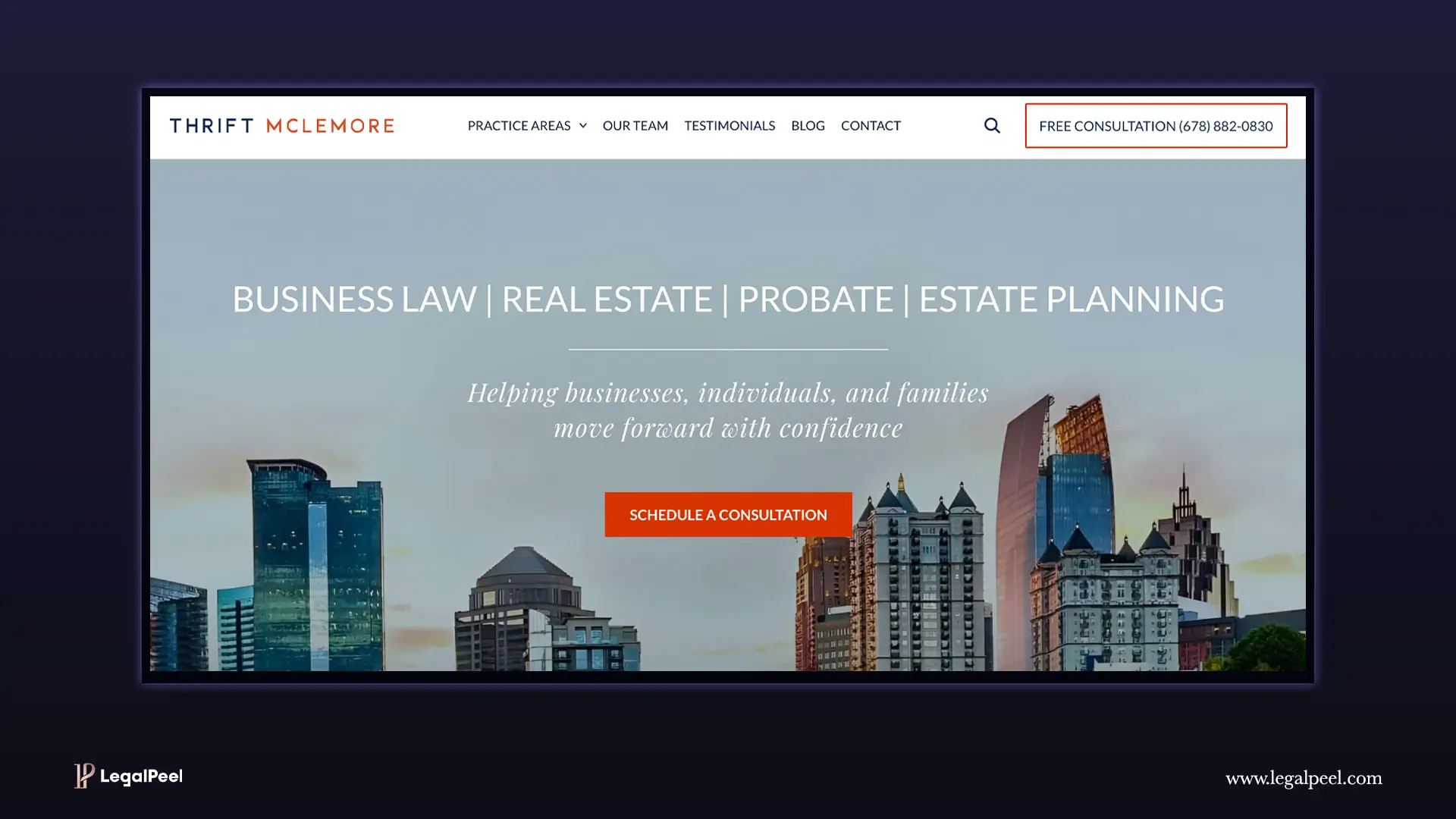
Thrift McLemore is a sample lawyer website example to strengthen your small law online presence.
Their website features only important sections on the homepage, like hero sections, ratings and reviews, clear practice areas, and testimonials.
Thrift McLemore presented a clear value proposition in the hero copy that they serve estate planning, business law and real estate.
With essential pages like contact us, testimonial, blog, practice area, and service segmentation, Thrift MC Lemore directly targets users and dominates SEO as well.
Also, they have separate attorney profiles with professional headshots.
Bonus : Don’t know how to budget for your law firm? Read guide on law firm website design cost and avoid overpaying for small firm site.
6. Bain Mazza & Debski LLP

Bain Mazza & Debski LLP is a bestsmall law firm website inspiration for solo attorneys.Only 3 attorneys are making their Bay Area law offices' online visibility a case-winning platform.
Bain Mazza and Debski LLP chose a very elegant brand color and built a modern lawyer website design.
Easy navigation bar in heading stands out for its focused positioning in employment law and personal injury, making it immediately clear who they serve. Practice area sections are labelled with common client concerns.
The site uses multi-location contact details and a persistent free case evaluation CTA to drive conversions at every turn.
Client testimonials deepen trust, while visible attorney profiles make the firm feel approachable and authoritative.
Strategically placed CTAs and clear information architecture support both user experience and lead generation goals.
Inspired by this website design? You can even get a more professional small law firm website with LegalPeel. Reach out to us.
7. Hoffman Law Group
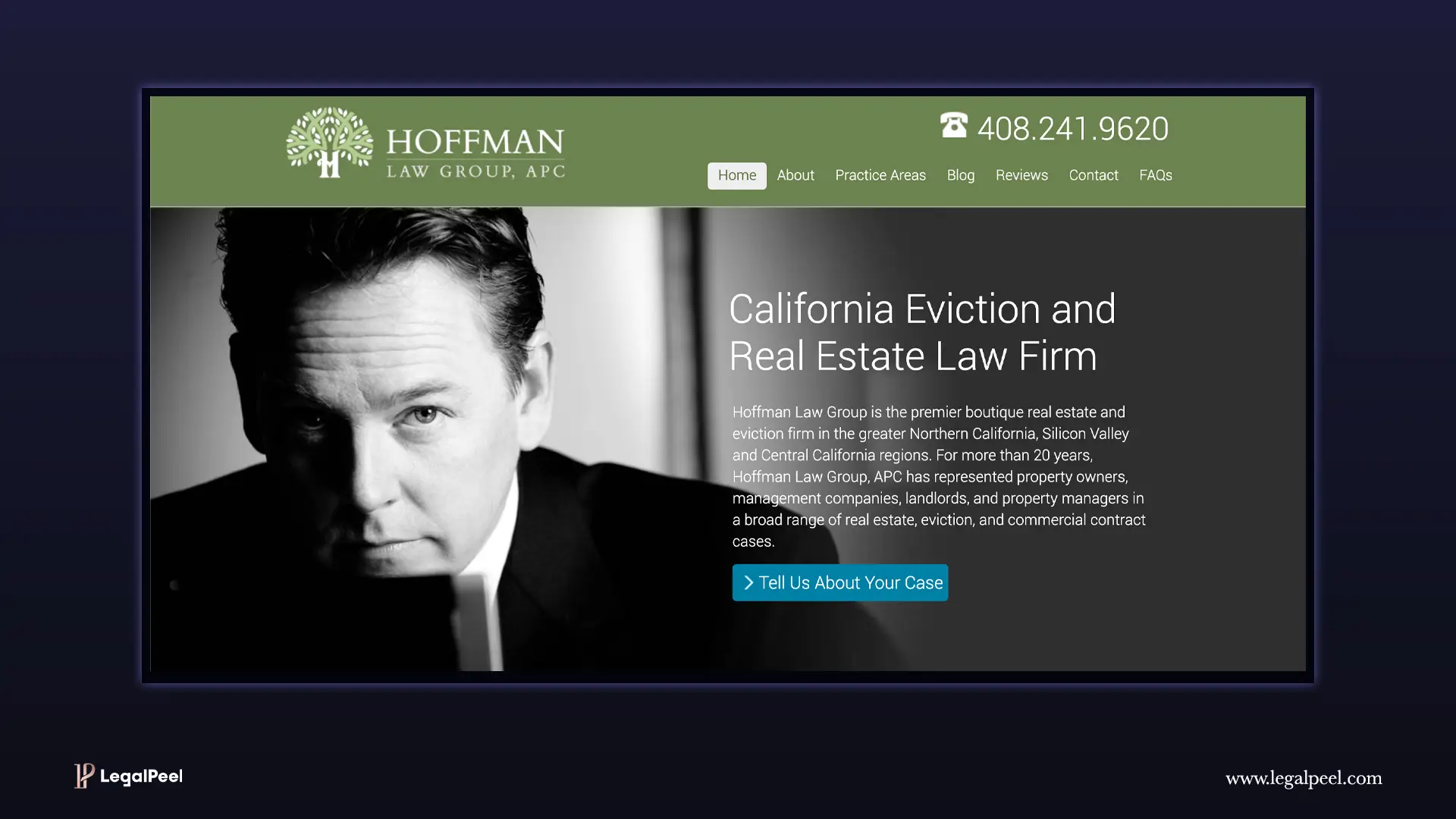
The Hoffman Law Group website serves as a focused and professional online presence for a specialized real estate and eviction law firm.
Contact information and location details are highly accessible, supporting direct engagement, while practice area segmentation helps visitors immediately find relevant legal solutions.
Strategic calls-to-action like “Schedule Your Free Case Evaluation” and click-to-call phone links help convert motivated local searchers into leads, making this site a strong example of UX-driven legal web design for a boutique firm.
8. Turnbow Law Firm
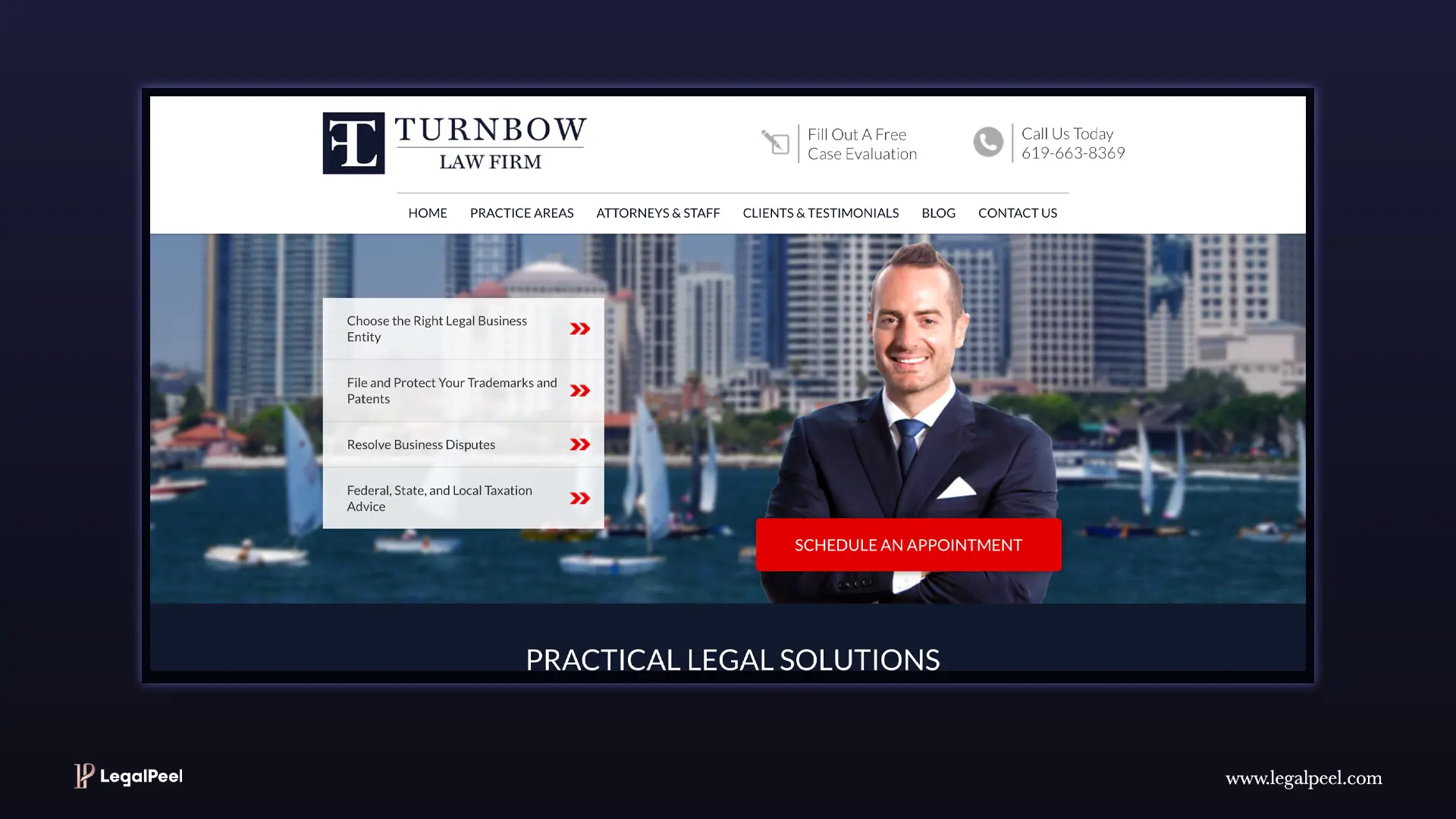
Turnbow Law Firm is one of the best websites for small law firms for its simple and intuitive design.
William Turnbow has an exceptional website with essential pages and clear attorney images for authority and trust.
Clear practice areas section, free case review and contact number on the hero section folder made contact easily accessible. It's the best strategy for lead generation through an attorney's website.
Turnbow and his paralegal are leading the small law office, and their website clearly defines that.
Explore best solo attorny website for more inspiration
9. Miller & McGing
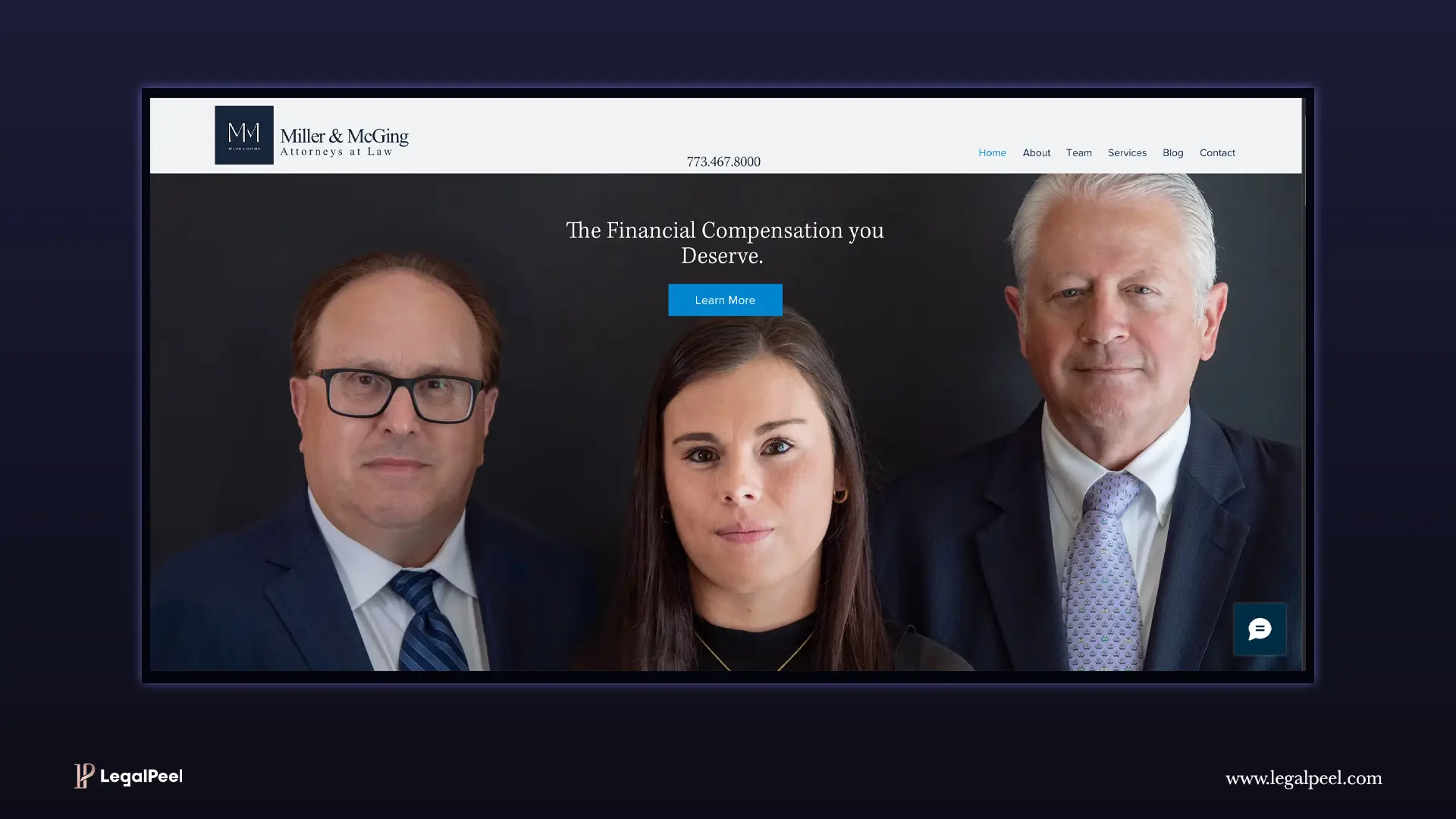
Miller & McGing is one of the best attorney website designs for boutique law firms.
Their established attorney website design reflects how they represent professionalism with modern, branded websites.
A tagline right up front, "The Financial Compensation You Deserve”, gives clarity and purpose within seconds.
Simple navigation structure, multiple conversion paths, and strong testimonials with attorney experience make their firm more authoritative and professional.
10. Lieb and Lieb Law Firm
.webp)
Lieb and Lieb law firm presented a clear value proposition with 30+ years of experience at reasonable rates.
That means, legal leads searching for lawyers immediately can be convinced and contact with a visible phone number, free consultation, map address.
They show how they pay attention as boutique law firms to their clients throughout over website copy, branding and creative interfaces. Lieb and Lieb firm has only essential pages with a clean layout – A perfect boutique law firm web design.
Bonus: Explore 10+ best small and solo law firm website designs, including family law firm, personal injury law, employment, estate planning, and business law firms.
[[inner-cta]]
How to Build Your Small Law Firm Website
Build your small law firm’s website with the right website builder, mapping local SEO keywords and service pages, choosing semi-custom templates and maintaining ADA compliance.
Otherwise, your static website will no longer help you to generate potential clients.
Choosing the Right Website Builder Platform
You should choose a website builder platform first to create a law firm website.
The best website builder for a small law firm is Webflow, WordPress, Wix or Squarespace.
Overall, Webflow is the best option for SEO, faster speed, user-friendly CMS, security and compliance-ready law firm website.
So, if you need a website not only for visual appeal but also for conversion, you can go with Webflow.
LegalPeel builds 20+ custom Webflow websites for small law firms. And, each firm experiences higher SEO performance, better leads and ROI from the first 3months.
Custom vs Template-Based Web Design
Most small firms start with legal website templates to build law firm websites quickly and easily.
Template-based law firm websites are great for affordability. But choosing a semi-customized law firm website design at a budget is an effective way.
Essential Website Pages for a Small Law Firm
Fear of missing any important pages? As a small law firm, you should have basic pages with clear copy and intuitive interfaces.
You should include home, about, services, contact and blog pages in your new firm’s website.
SEO and Local Visibility Setup
Some law firm owners are thinking of creating websites without SEO for budget-conscious conscious. You may think the same.
Prioritize local SEO optimization setup with every service page and city+practice area pages from day one. It'll give you higher local visibility and legal lead generation.
Pro Tips: You can choose LegalPeel's affordable small law firm website design packages starting from $3k with SEO optimization.
Launch a Small Law Firm Website Without Fear
Don’t lock yourself into a high-budget website contract that doesn’t make sense for a small firm. At the same time, relying on a DIY template website can damage your first impression and weaken your firm’s credibility.
You need essential pages, smart branding, and a manageable CMS that works for both your clients and your marketing team.
Otherwise, you’ll face constant headaches —small updates becoming costly, inflated fees, and little to no real results.
Get rid of the fear.
If you're looking for a custom lawyer website built with 2026-ready features, essential pages, smart UX, SEO and strong branding at an affordable price, we can help.
Reach out to LegalPeel today.
[[last-cta]]
.webp)
Personal injury leads can cost $50 for a shared web form to over $4,000 for a live-transfer call.
Case type, market, lead source, exclusivity, qualification, and how fresh the inquiry is when it lands in your inbox actually drive the cost.
Here's the part most pricing guides skip. Cost per signed case is. A $400 lead that converts is cheaper than a $100 lead that never picks up the phone.
In this article, we'll give you a transparent, detailed pricing breakdown so your investment goes further, from PI lead cost to winning cases. Keep reading.
Average Cost of Personal Injury Leads
PI leads can cost anywhere from $100 to $600, depending on several factors.
For example, a personal injury attorney targeting car accident leads in a competitive market like Atlanta may pay twice as much as an attorney targeting leads in a smaller market like Macon, where there are typically fewer law firms bidding for the same potential clients.
[[inner-cta]]
Factors that Determine the Cost of a PI Lead?
The eight most underrated factors that determine how much you should charge for getting personal injury leads. Here's the list
- Case value — the higher the expected settlement, the more a lead is worth bidding on
- Case type—auto accidents are common and cheaper; trucking and medical malpractice are rare and expensive
- Location—competitive metros like LA, Chicago, and Atlanta push prices toward the top of the range
- Competition — how many firms are bidding for the same keyword or the same lead
- Search intent—someone typing "car accident lawyer near me" costs more than someone reading a general injury article
- Exclusivity — Whether the leads are sold to one firm or several.
- Qualification requirements — the more screening built in, the higher the price
- Lead freshness—real-time is better than aged.
Personal Injury Lead Pricing by Lead Generation Channel
Law firm lead generation services mainly focus on two ways. One is organic marketing, and the second is paid marketing. Well, the system of generating legal leads is crucial to know before you invest money.
SEO-Generated Personal Injury Leads
Organic search is the slow-build option but a profitable one. And SEO and AEO services for law firms make that lead gen more successful.
Website, blog, and SEO are the #1 ROI-generating channel according to 27% of marketers.
Ranking for terms like "personal injury lawyer [city]" takes ongoing content and local SEO work, and it doesn't produce leads on day one.
But once a page ranks, the leads it generates keep coming without an added cost per click.
Firms that invest early in SEO and web design packages built around lead generation tend to end up with the lowest long-run cost per lead of any channel. Even though the upfront investment is higher than turning on an ad campaign.
Quick win: LegalPeel helped Dorsel Law combine a conversion-focused website, SEO, and lead generation to generate 9 successful clients within just 2 months.
Google Ads and PPC Leads
PPC gets you in front of high-intent searchers immediately, and it costs accordingly.
Personal injury Cost-per-click runs 70–250 in most markets, and competitive terms in major metros can exceed $500 per click.
Well, here are the things lawyers can make mistakes about. The reminder is that not every click becomes a lead, and not every lead converts. So your real cost per lead sits well above the CPC once you account for landing page conversion rates.
Local Services Ads Leads
Google's Local Services Ads show up above traditional search ads and charge per lead instead of per click.
Personal injury lawyers mainly make profit from this LSA service to get maximum leads.
Typically, LSA-generated personal injury leads cost 250–500 per call. The upside is you only pay when someone actually calls or messages, not for every click that goes nowhere.
Social Media Leads
Facebook and Instagram lead ads are cheaper per click than Google Ads, but the audience isn't actively searching for an attorney. They're scrolling.
That gap shows up in lower intent and lower conversion, which is why social leads tend to cost less upfront and more in follow-up effort to actually sign.
Purchased Personal Injury Leads
Third-party lead providers run their own ad campaigns, capture the inquiry, and sell it to one or more law firms.
This is where most of the "how much does a PI lead cost" pricing you'll find online comes from, and it's the fastest way to add volume without building your own acquisition system.
Live-Transfer Personal Injury Leads
A live transfer is a pre-screened prospect connected to your intake team by phone, in real time.
It's the most expensive model, often 1,000–4,500 depending on case type, because it removes the speed-to-lead problem entirely. The trade-off firms run into: you pay for the transfer whether or not the case actually signs.
CPL vs. Cost Per Signed Case: Which Metric Matters More?
What Is CPL?
Cost per lead is exactly what it sounds like: total spend divided by the number of leads generated. It's the number every vendor quotes you, and it's the least useful number for deciding whether a channel is actually working.
What Is Cost Per Signed Case?
Cost per signed case is total spend divided by the number of leads that actually became clients. It accounts for conversion rate, not just sticker price, and it's the number that tells you whether your marketing dollars are turning into revenue.
Example: A $100 Lead vs. a $300 Lead
The cheaper lead looks like the better deal until you run the math past the purchase price. This is a hypothetical example, but the pattern shows up consistently in real firm data: exclusivity and qualification usually win on cost per signed case even when they lose on cost per lead.
How to Calculate Your Personal Injury Lead ROI
The formula is simple:
Total lead spend ÷ number of signed cases = cost per signed case
Then compare that number against your average case value. A reasonable target is keeping cost per signed case under roughly 10–15% of what you expect the case to settle for.
If a case is worth $20,000 in fees, spending $2,000–$3,000 to acquire it is defensible. Spending $8,000 isn't, no matter how cheap the individual leads looked on the invoice.
Buying Personal Injury Leads vs. Generating Your Own Leads
Advantages of Buying Personal Injury Leads
- Faster pipeline with no ramp-up period
- Less internal marketing work to manage
- Predictable lead volume month to month
- Access to acquisition systems already built and tested
Disadvantages of Buying Leads
- Ongoing cost that never goes away
- Dependency on a provider's traffic quality and screening
- Shared-lead competition eating into conversion rates
- Quality that varies by vendor and by month
Advantages of Building Your Own Lead Generation System
- Full control over targeting, qualification, and follow-up
- Long-term SEO value that compounds instead of resetting every month
- Brand ownership instead of borrowed traffic
- First-party data on what's actually converting
- Lower acquisition cost over time as organic channels mature
Which Model Is Right for Your Law Firm?
If you need case volume this quarter, buying leads fills the gap faster than any organic system can ramp up. If you're building for the next three to five years, a firm-owned system through SEO, web design, and a real lead-generation infrastructure is the one that keeps paying off after you stop spending on it.
Most solo and small PI firms end up running both: purchased leads for near-term volume while the organic pipeline builds underneath them.
How LegalPeel Helps Personal Injury Law Firms Generate Leads
Here’s how LegalPeel makes the lead generation pipeline more valuable than so-called lead gen vendors by selling cheap PI leads
Step 1: Identify the Ideal Personal Injury Client
We ask you several questions, such as about your firm, goals, lead source (you are interested in), your income streams, and your firm's capacity to handle cases per month.
Then we define case type, injury severity, and geography before any traffic is bought, or every dollar spent afterwards is aimed at the wrong audience.
Step 2: Build the Acquisition Strategy
Next, we make and refine the lead gen process exclusively for your firm. For example, SEO, PPC, LSAs, email campaigns, or social media—usually some combination—are chosen based on budget, timeline, and how competitive the target market is.
Step 3: Make sure the Acquisition System is Fully Ready
We again refine your lead tracking and automation system [or even build it], like website landing pages, contact forms, social media profiles, and local pages where leads will land and make decisions. So, when potential legal leads came, you were confident to make a call to your firm as their first choice.
Note: 78% of businesses lose customers due to no lead tracking system. Unlike other law firm lead generation vendors, we make sure your every single dollar pays for the highest-chance leads, not any waste.
Step 4: Generate Qualified Traffic
We either run ads and bring in visitors or build an organic marketing pipeline for getting leads who are actually searching for an attorney, not just anyone reading about accidents.
Step 5: Capture the Lead
A landing page or form converts that visitor into contact information. This step alone is where a lot of paid traffic gets wasted, since a slow or confusing landing page kills conversion before the lead ever reaches intake.
Monitor and analyze the automated lead tracking system with continuous and transparent reporting.
Tips: We design and build lead-generating legal tools for law firms across the U.S. If you want your firm to have a free FOIA generator, intake form wizard, or automated legal PDFs, we can build it under your brand.
Step 6: Qualify the Inquiry
We help establish qualification criteria to filter out inquiries that don't fit your firm's requirements, such as the wrong practice area, someone who is already represented, or a case outside the applicable statute of limitations.
This helps your intake team spend more time on opportunities that have a realistic chance of becoming signed cases.
Step 7: Route the Lead to Your Law Firm
Once a lead is captured and qualified, it needs to reach your team quickly.
Depending on your setup, leads can be routed through phone, SMS, email, or CRM integrations, helping your intake team respond while the potential client is still actively looking for legal help.
Step 8: Optimize for Better Cost Per Signed Case
We continuously evaluate campaign and case-level performance, cut what isn't working, and shift resources toward the channels and case types producing signed cases at the best cost per acquisition.
That's the difference between simply buying personal injury leads and building a personal injury client acquisition system.
[[last-cta]]
Is Buying Personal Injury Leads Worth It in 2026?
Yes, but not every personal injury lead is worth buying. When Buying PI Leads Makes Sense
Buying leads can make sense when your firm:
- Needs cases faster than SEO can produce them
- Has available intake capacity
- Is entering a new geographic market
- Wants to test a new practice area or case type
- Has a reliable follow-up and intake process
- Can track leads through consultation and signed case
Buying leads can solve an immediate volume gap, but it doesn't build an asset your firm owns. LegalPeel's personal injury marketing services focus on building a lead-generation system around your own website, search visibility, landing pages, lead capture, qualification, and intake.
Instead of optimizing for cheap leads, we track cost per signed case and identify what's actually driving revenue. If your website is hurting conversion, that's often the first thing to fix before increasing traffic.
Want a more predictable way to generate personal injury cases? Talk to LegalPeel about building a system around your firm's market, practice area, and growth goals.
.webp)
There are more than 1.3 million lawyers in the United States. According to the American Bar Association's 2025 Profile of the Legal Profession, that number just climbed to 1.37 million, up from 1.35 million the year before. The first increase since 2020.
That doesn't mean all 1.37 million lawyers are competing for the same personal injury client in the same city. But it does mean a generic law firm website isn't much of a differentiator anymore. Blue color scheme, stock photo of a gavel, and aggressive advocates in the hero. That template has been copied so many times it's basically invisible now.
The firms winning consultations in 2026 aren't winning because of animations or a bigger hero image.
Good personal injury lawyer website design isn't about looking impressive. It's about removing every reason a hurt visitor has to leave. We pulled real examples to show what that actually looks like.
What Makes a Personal Injury Law Firm Website Stand Out?
Look at any list of the best personal injury attorney website designs. Good personal injury attorney website design isn't about more features; it's about the right handful done well.
Problem-Focused Messaging
A hurt visitor doesn't want a law firm history lesson. They want to know two things fast. Can this firm help me? What do I do next? The sites that convert answer all in the first screen, before any scrolling.
Strong Above-the-Fold CTA
"Contact Us" is weak. It doesn't tell a visitor what happens after they click. "Free Case Evaluation" or "What's My Case Worth?" does more work because it names the outcome instead of the action. Before designing your PI law firm, get the proven 7 CTAs for law firms that convert.
Trust Signals That Reduce Hesitation
Bar association badges matter less than most firms think. What actually reduces hesitation is specificity. Real verdict numbers. Named attorneys. A process the visitor can picture before they call.
Case Results and Social Proof
Numbers without context are just numbers. The firms that do this well attach a sentence of what happened, not just a dollar figure floating on the page.
Attorney Branding That Feels Human
Stock photos of handshakes and gavels don't build trust. A real photo, a real name, a modern law firm logo, and a sentence in the attorney's own voice do more in three seconds than a page of credentials.
Mobile-First UX
Most PI searches happen on a phone, often right after an accident. That means tap-to-call has to be visible without scrolling, and forms need to be short enough to fill out with one thumb.
See best small law firm website design inspiration in 2026.
8 of the Best Personal Injury Lawyer Websites Design Inspiration Right Now
1. Gomerman | Bourn & Associates
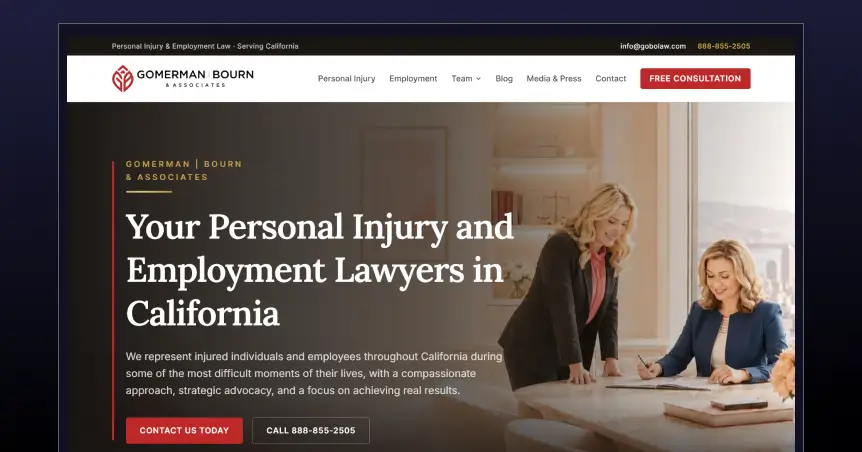
Gomerman | Bourn is a women-led California firm handling personal injury and employment cases.
What stands out is the credibility wall right under the hero: Super Lawyers, Multi-Million Dollar Advocates Forum, ABOTA, and a Yelp badge, stacked together instead of scattered through the site. This works because it front-loads proof before asking for anything.
What other firms can copy: pair a clear identity statement, in this case "women-led trial lawyers," with a six-step "how your case moves forward" timeline so a nervous visitor can see the whole path before they ever call.
How much does an attorney website cost? Get detailed pricing of web design, development, and monthly cost breakdown now.
2. Ray Pearson Law
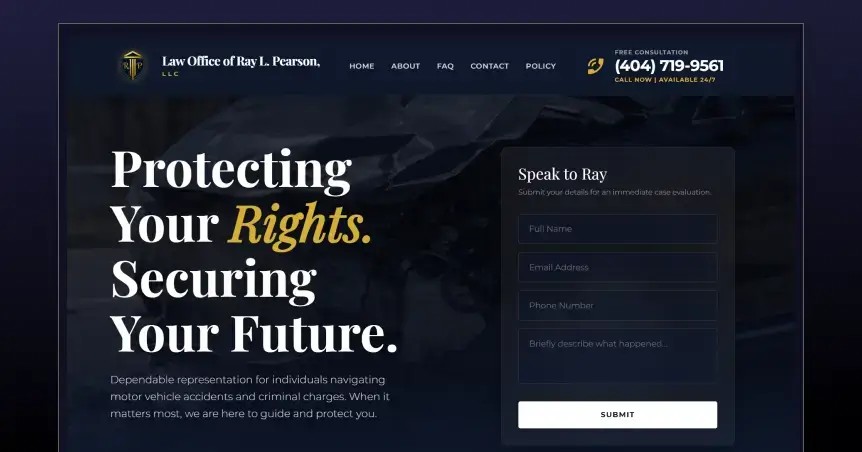
This is a solo Atlanta attorney's site, and it's built like one.
A background video plays behind the hero, and right next to it sits a two-field "Speak to Ray" form, not a button that sends you somewhere else. That's the smart part.
It shrinks the distance between "I'm interested" and "I've made contact" down to a few seconds. Small firms with one attorney can copy this directly: put a mini contact form in the hero itself instead of hiding it behind a nav link.
3. The Weinstein Firm
.jpg)
Weinstein has built out dozens of city and practice-area pages across metro Atlanta, from MARTA accidents to negligent security.
Why it works: instead of one generic "personal injury" page trying to rank for everything, each page targets one real, searched scenario.
The site also runs a settlement calculator and video testimonials instead of only text quotes. The lesson for growing firms: local SEO scale isn't about more pages for the sake of it; it's about a dedicated page for every specific way someone in your area actually gets hurt.
So, how much should you spend on SEO when launching a new law firm website? Read out now.
4. Butler Kahn
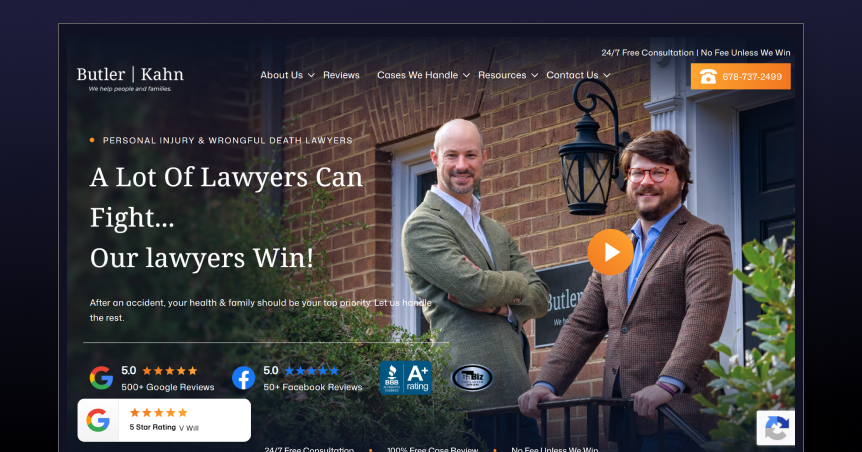
Butler Kahn does something almost nobody else in this list does.
Their homepage design and copy actively talk people out of hiring them if they want a volume firm: "If you want a law firm to assign your case a number... don't hire us."
That's a bold move, and it works because it turns selectivity into the trust signal. Paired with real verdict numbers like a $150 million wrongful death case, the contrarian voice reads as confidence.
Firms with strong results and limited capacity can borrow this: don't be afraid to say who you're not for.
[[inner-cta]]
5. Ellis Law Firm
.webp)
Willie Ellis spent sixteen years working for insurance companies before switching sides, and the whole site is built around that pivot.
The hero doesn't open with a tagline about fighting for justice. It opens with an iceberg: "The real strength of your case is beneath the surface."
That's a sharper way to say the same thing every PI site claims, and it's backed by a simple three-step "how it works" section right underneath.
The takeaway here: a single strong metaphor tied to a genuine credential beats five generic value props.
6. The Weinsten Firm
The Weinsten Firm is a national brand, and their Atlanta page shows what that looks like done right instead of lazily. The page is built for one metro with local practice-area links, a bilingual Español option in the main nav, and a media trust bar from NBC, CNN, and Bloomberg. What smaller firms can take from this: even a single-location site benefits from treating every local page like its own small homepage, not an afterthought bolted onto a national template.
7. Atlanta Accident Lawyers

Most PI sites ask for a phone number before giving anything back. Atlanta Accident Lawyers flips that with a free police report lookup tool, offered before the pitch.
It's a small thing, but it's a real reason to visit the site even if someone isn't ready to call a lawyer yet. That's a smarter first touch than another "free consultation" banner, because it gives value up front instead of just asking for one.
Living in Atlanta and concerned about how to build a personal injury website design on a budget?
Get details and a guide on how much a personal injury website costs in Atlanta.
8. Danni J Law

Danni J. Law handles both personal injury and criminal defense, including DUI, gang crimes, and domestic violence, on the same homepage as their PI practice. The writing is warm, and the attorney bio is genuine, but the mixed positioning muddies the message.
A visitor with a car accident case lands on one that covers felony defense. The lesson: crossover practice areas need separate paths, not one shared homepage trying to speak to two very different kinds of visitors at once.
Personal Injury Lawyer Website Design Features That Actually Matter
Not every feature on this list earns its place. Here's what actually moves the needle:
- A hero section that names the outcome, not just the action
- Click-to-call and a short intake form, both visible without scrolling on mobile
- Real case results with context, not floating numbers
- Practice-area pages built around specific scenarios, not one catch-all page
- A trust signal that's specific to the firm, not a generic badge everyone has
- A tool or resource offered before the ask, like a settlement calculator or a police report lookup
Skip the rest. Sliders, autoplay carousels, and stock photography don't move a scared, injured visitor any closer to picking up the phone.
Look out what personal injury lawyers follow in the web design trend in Atlanta
How to Build a Personal Injury Law Firm Website That Converts
Most firms hire out website design for personal injury lawyers and still end up with a template. Here's the actual framework, not the template.
- Define the one thing your firm is known for, whether that's trial experience, a specific case type, or personal attention.
- Build the homepage around what an injured visitor needs first, not around your firm's history.
- Create separate, focused pages for each major case type rather than one page that tries to rank for everything.
- Add real proof: case results with context, attorney photos, and specific credentials.
- Make contacting the firm take seconds, especially on mobile
- Optimize for the phone visitor first, then adapt up to desktop
- Build local SEO into the page structure itself, not as an afterthought
- Track what visitors actually do on the site, and fix whatever step loses the most people
Final Takeaway
A great personal injury website isn't the one with the most animations or the biggest hero image. It's the one that makes a hurt, worried visitor think this firm gets my situation, and I know exactly what to do next.
That's harder to build than it sounds. It takes clear positioning, real proof, and a site built around trust instead of decoration. If your current website is asking visitors to work for that clarity instead of handing it to them, that's usually where the leads are quietly leaking out.
That's the exact gap LegalPeel builds law firm websites to close. If you want a second opinion on where yours might be losing consultations, we're happy to take a look.
[[last-cta]]
.webp)
A successful law firm website redesign was completed a month ago. From the placement of a single button to full user journey mapping, we reviewed what wasn't working and rebuilt what needed to work as hard as a 10+ monthly retainer case.
We worked with The Durrett Firm: eight years open, four attorneys, and a steady reputation in Columbus. Referrals had stopped growing.
70% of new inquiries still came through referrals. Search traffic existed. But it didn't convert. Here's what was actually happening on the site, what we fixed, and how consultations increased.
Where the Old Site Was Losing Cases

1. The homepage led with so much information
Instead of mapping visitor psychology, they were outlined on the homepage alongside generic website UX principles. Like, awards, years in practice, and memberships came first.
For physicians and healthcare businesses looking for legal counsel, the first question is simple: "Can this firm actually help with my situation?"
That answer wasn't immediately clear.
2. Attorney bios read like resumes
Poor headshots and dummy legal images across every attorney bio. Users don't have enough time to read that much information, like bar admission, case history, education, and such fluff! So it makes it difficult for legal leads to trust the attorney and close the tab.
The problem wasn't a lack of credentials. It was how those credentials were presented.
Physicians looking for legal counsel need to understand who they're dealing with, what that attorney actually handles, and why they should trust them with a sensitive legal or business matter.
3. Practice area pages ran under 400 words
Business formation, contract review, employment issues, regulatory compliance, medical licensing, HIPAA compliance, practice transactions, and risk management—each page just listed the service and stopped there.
No clear explanation of the legal issue, no context around what physicians or healthcare businesses should expect, and no idea what actually happens next.
Users can't decide to trust a firm with an important healthcare legal matter off a page that thin. They just leave and keep searching.
Average time on page was under 40 seconds.
4. Mobile navigation took several taps to reach a practice area
No shortcut from the homepage to the specific type of legal service someone was searching for.
Five-plus taps just to find the right page, and many of these users are one-handed on a phone while trying to deal with an urgent legal or business issue.
A lot of them didn't bother finishing the journey. Mobile bounce rate sat close to 40%.
5. Testimonials lived on their own separate page
Disconnected from any page where someone was actually deciding.
Nobody clicks a standalone "Testimonials" tab unless they're already sold on the firm.
The physicians and healthcare professionals still comparing three firms in other tabs never saw a single review.
That page pulled under 2% of total sessions.
6. CTA buttons were inconsistent
Different wording, different placement, different styling depending on the page. "Contact Us" here, "Free Consultation" there, "Get Started" somewhere else, and never in the same spot twice.
Users had to relearn where to click on every page, and a lot of them just gave up trying.
Find out 7 proven CTA for a law firm that converts visitors into clients
7. Site was slow
Oversized images, outdated plugins, sluggish load times on mobile.
Nobody's sticking around 5+ seconds for a page to load, especially a physician or healthcare business owner already dealing with a time-sensitive legal matter.
Load time alone was probably costing consultations before anyone even read a word.
[[inner-cta]]
How We Fixed It
1. Rewrote the homepage around the visitor
Led with the type of legal matter someone is dealing with—physician counsel, healthcare business needs, contracts, compliance, licensing, and practice transactions—before introducing awards or credentials.
Like, the legal need came first now, and the credentials moved down instead of out.
So visitors get "yes, we handle this" in the first few seconds instead of scrolling past achievements first.
2. Rebuilt attorney bios for trust
Real headshots and copy that leads with how each attorney actually talks to a physician or healthcare business instead of opening with bar admissions.
Like, the fluff moved lower, and the human part moved up.
So visitors get a reason to trust the person, not just their credentials.
3. Expanded every practice area page
.webp)
Built around the actual questions physicians and healthcare businesses need answered— contracts, regulatory requirements, licensing, HIPAA compliance, practice transactions, employment matters, and risk management—worked into the page itself, not bolted on as an FAQ.
Like, the answers people actually needed were finally on the page instead of missing.
So visitors had a reason to stay and read rather than bounce to a competitor.
4. Cut mobile navigation down to the fewest taps possible
Straight path from the landing page to the right legal service and the consultation request.
Like, no more digging through menus one-handed while trying to find the right type of legal counsel.
So fewer people dropped off before they even reached a consultation form.
5. Moved testimonials off their own page
Placed next to the consultation forms on relevant service pages, right where hesitation shows up.
Like, reassurance shows up exactly when someone's deciding, not three clicks away.
So the testimonials actually reached the people who needed convincing.
6. Standardized every CTA
One wording, one placement, one style, repeated identically site-wide.
Like, "Free Consultation" everywhere now, same spot, same look.
So visitors never had to relearn where to click.
7. Fixed page speed and refreshed the visual identity
Compressed the images, removed outdated plugins, and modernised the design without losing the approachable tone.
Like, the site stopped losing people before they even read a word.
So it stopped looking out of step next to competitors too.
Project Timeline
8 weeks total—from discovery to final development and QA.
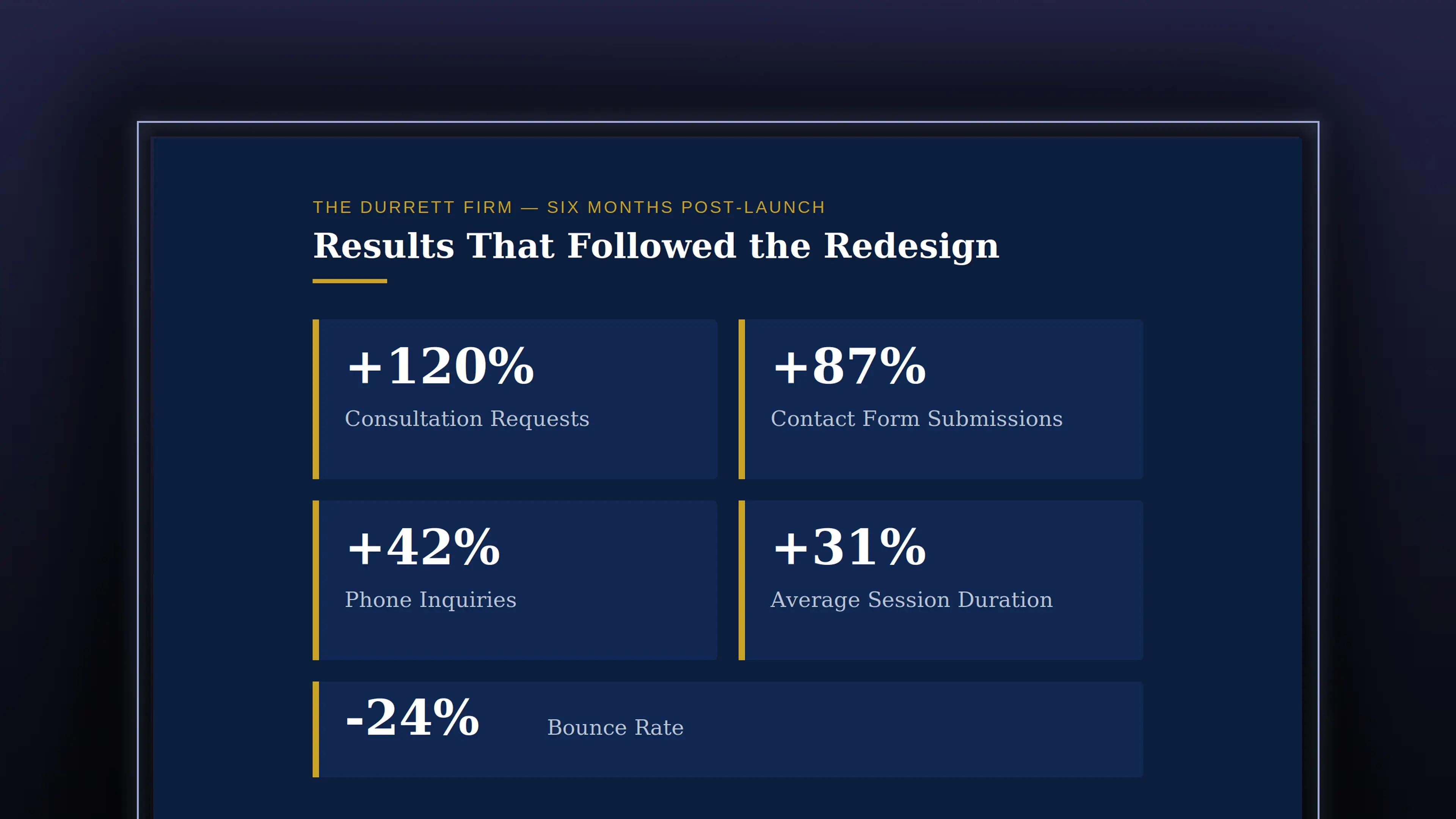
Week 1 — Discovery & Strategy
- Audited the existing website, navigation, practice areas, bios, CTAs, and mobile experience.
- Mapped key visitor journeys for physicians and healthcare businesses.
- Defined the new site structure and conversion priorities.
Weeks 2–3 — UX & Wireframes
- Restructured navigation and practice area pages.
- Reworked the homepage around visitor needs.
- Planned attorney bios, CTAs, testimonials, and mobile journeys.
- Created desktop and mobile wireframes.
Weeks 4–5 — Visual Design
- Developed the new visual direction.
- Designed the homepage, practice area pages, attorney profiles, and key inner pages.
- Standardized CTAs, typography, imagery, spacing, and trust elements.
Weeks 6–8 — Development & QA
- Built the approved designs responsively.
- Implemented navigation, forms, CTAs, and conversion paths.
- Optimized performance and tested across devices and browsers.
- Completed final QA, revisions, and launch preparation.
What to Take From This
For The Durrett Firm, that meant rebuilding the website around how physicians and healthcare businesses actually search, evaluate, and choose legal counsel.
If your website gets traffic but isn't turning visitors into consultations, it may not need more traffic; it may need a better user journey.
Think your law firm website is losing potential clients? Let LegalPeel audit your website and find the conversion gaps.
[[last-cta]]

A branding agency for lawyers should cost $800 to $3,500 for a solo or small firm. If a proposal lands closer to $20,000, you're not being scoped as a solo practice. You're being scoped as a regional firm without a marketing department. And you're about to pay for a process built for someone else's budget.
That's usually the first thing that comes up across the table. So let's start there and work through the rest the way it actually comes up in a consultation.
What a Legal Branding Agency Should Actually Deliver
"I already have a logo I like. Isn't that most of it?"
No. This is the mistake that costs firms the most money for the least result. A logo is one output of branding. It isn't the branding itself.
A real legal branding agency should hand you five things:
- Positioning: the one-sentence answer to why a client should pick you
- Messaging and voice: the actual language your site bios and marketing use
- Visual identity: logo, palette, and typography built last, not first
- Brand guidelines: so the tone doesn't drift the next time someone writes a page
- Attorney bio direction: because a bio written like a résumé does nothing for positioning
Positioning comes first because everything else is downstream of it. You can't write messaging that doesn't exist yet. You can't design a visual identity around a decision nobody's made. Visual identity sits third on this list because it's the part every agency defaults to leading with. It's the easiest thing to show you in a first meeting.
If a proposal only lists the visual identity line, you're buying a design package with a branding invoice attached. That's fine if that's genuinely all you need. It's a problem when you were told it was a full rebrand. If a logo really is the piece you're missing, see what actually makes a law firm logo work before you approve one.
[[inner-cta]]
What a Branding Agency for Law Firms Should Cost
"Every quote I've gotten is wildly different. How do I know what's fair?"
Because agencies aren't quoting the same scope even when the deliverables list looks identical on paper.
Enterprise legal branding firms routinely quote $16,000 to $63,000. That price isn't wrong. It's built for a 60-attorney firm rolling a brand across multiple offices with partner sign-off cycles and a marketing team to manage it. It's simply the wrong tool for a five-lawyer firm. A firm wouldn't hire BigLaw litigation rates for a landlord-tenant dispute either.
The tell isn't the price. It's whether the agency has a second process built for firms your size or just runs everyone through the same enterprise intake.
If you're weighing branding against a website and SEO spend at the same time, our full website, SEO, and branding package breakdown shows how those budgets fit together, or you can check current pricing directly.
Should Branding Come Before the Law Firm Website?
"My website's outdated too. Do I fix that first or the brand?"
Brand first. When both are on the table at once, this isn't a preference. It's sequencing.
Your website's structure and copy and even its practice area page architecture should be built around your positioning. Build the site first; you're designing a container for a message you haven't decided on yet. That means rewriting copy the moment the branding work catches up. Or worse, never circling back to it at all.
If your website already works, you don't need to freeze everything for a ground-up rebrand. A messaging and visual refresh can be layered onto an existing site as long as the positioning underneath it gets resolved first. What doesn't work is redesigning the site around a brand that hasn't been decided yet and hoping it lines up later.
If you're starting from nothing, here's the right order to build a solo firm's website, branding, and SEO from day one.
How to Tell If a Branding Agency Actually Understands Law Firms
"They all say they understand our industry. How do I actually check?"
Ask one question. What happens in our first working session before design starts?
An agency that understands law firms will ask about your practice areas, your competitors, your ideal client, and how prospective clients actually evaluate a firm before they call. An agency that doesn't will start talking about mood boards, fonts, and brand vibes. That gap shows up in the first fifteen minutes if you know what to listen for.
What a legal branding agency should ask you first:
- How clients currently find and choose you today
- What your competitors in the same city or practice area are doing
- Which practice areas actually drive revenue versus which ones just take up homepage space
- How your intake team or you personally handle the first call once a lead comes in
- What clients say when they explain why they hired you over another firm
What it means if they skip straight to this instead
- Logo concepts before any of the above has been discussed
- Color palette options framed as the first deliverable
- Generic brand personality language like bold or modern or trustworthy with no connection to your actual client base
- A moodboard presented as strategy
None of this shows up in a portfolio. A beautiful portfolio proves an agency can design. It doesn't prove they know a criminal defense client evaluates a firm differently than a business formation client. Or that your bios do more positioning work than your homepage. The only way to actually test for it is to sit through that first working session and see which list it matches.
Still building your shortlist? Here's a breakdown of law firm branding agencies across the US to compare against this list.
Red Flags to Avoid When Hiring a Branding Agency for Law Firms
Any one of these is reason enough to keep looking. You don't need all three to walk away.
No positioning conversation before design begins
That's a design shop wearing a branding label. If the kickoff call jumps straight to visual references and inspiration boards, there's no strategy step happening behind the scenes. You'll get a good-looking outcome that says nothing specific about your firm.
No brand guidelines in the deliverables
Without one, the first flyer or social post or new hire breaks consistency inside a month. Guidelines aren't a nice-to-have. They're what keeps your next intern's Canva post from looking like it belongs to a different firm.
Branding treated as a standalone PDF
A brand nobody applies isn't a brand. It's a deck. If the agency hands you a strategy document and has no plan for how it flows into your site copy, your practice area pages, or your Google Business Profile, ask who's supposed to implement it. If the answer is you, price that labor into the total cost before you sign.
Pricing that doesn't match your firm's actual size
A solo attorney quoting enterprise rates isn't getting a better process. They're getting the same intake as a sixty-attorney firm, minus the parts of the process that a firm that size would actually use.
Everything else is preference. Timelines. Personality fit. Portfolio style. These four are structural.
Does Branding Actually Affect SEO or AI Search Visibility
"Does any of this actually move the needle on rankings, or is it just how we look?"
Indirectly. More than most firms assume. But it isn't a ranking factor on its own.
Clear positioning produces specific page titles and content instead of the same generic personal injury lawyer copy every competitor in your market runs too.
Consistent messaging across your website bios and directory listings strengthens the trust signals AI search tools weigh before naming a firm in an answer. These are the same E-E-A-T signals Google has leaned on for years.
A defined voice also makes your bios read like an actual person practicing law instead of a template. That's exactly what Google and AI search both reward now.
An unbranded firm produces unbranded content. That content doesn't differentiate in a Google result. It doesn't differentiate in a ChatGPT answer built by comparing you against three other firms saying the same thing either. Once your positioning is set, pairing it with the right SEO and AEO work is what actually turns that clarity into rankings and citations.
The Standard to Hold Any Agency To
Here's the test. It's the same one we'd use across the table before recommending anyone. Does the agency talk about your positioning before your palette? Do they scope your firm's actual size instead of running you through an enterprise process? Do the deliverables include something you can actually hand your web team?
If the answer to all three is yes, the price range doesn't matter much beyond the table above. If any answer is no, the price doesn't matter either. You're paying for the wrong thing.
LegalPeel's branding and visual identity work is scoped this way from the first call. Positioning first. Design second. A direct handoff into the website and SEO work that puts it in front of clients.
[[last-cta]]
.jpg)
Roughly 28% of people already ask ChatGPT to find a lawyer.
But here's the problem. Most law firm websites were built for Google in 2019, not AI search in 2026.
So, what actually moves the needle on AI search visibility for law firms? We already broke down the strategy behind how to rank your law firm in ChatGPT and AI search. This is the checklist version. Print it, work through it, done.
The 15-Point Law Firm AEO Checklist
1. Verify AI bots can actually crawl your site
Check your robots.txt file first. If ChatGPT-User, PerplexityBot, or ClaudeBot are disallowed, your firm is invisible before you even start optimizing anything else.
A developer blocked bots years ago to stop scraping, and nobody has looked at that file since. Have someone check it this week.
2. Add LegalService and Attorney schema
Schema markup for law firms tells AI exactly who you are, what you practice, and where you're located. Without it, the model is guessing at facts it should already know.
At minimum, add LegalService schema to your homepage and Attorney schema to every attorney bio page.
3. Write FAQs in the exact words clients use
Not "Our Firm's Approach. Instead: "How much does a divorce lawyer cost in Georgia?" One question, one direct answer underneath, then supporting detail.
Pull these questions from your own intake calls. Clients don't ask in the marketing language.
4. Lead every page with a 40 to 60 word answer
AI extraction heavily weighs the first few sentences under a heading. Bury the answer in backstory about your firm's history, and it gets skipped entirely.
Write the direct answer first. Save the context, the case examples, and the credentials for the paragraphs underneath.
5. Build practice area clusters
A firm covering DUI, assault, and drug charges under one Criminal Defence hub reads as an expert entity to AI. One thin "Criminal Law" page reads as generic.
Depth beats breadth here. Personal Injury should branch into car accidents, truck accidents, and wrongful death, each with its own page.
Do I need a separate page for every sub-topic, or can I combine them?
Separate pages, if you want the citation. A combined page covering five topics in 600 words tells AI you know a little about a lot. Five dedicated pages at 800 words each tell AI you know a lot about each one.
6. Attach a real attorney bio to every article
Content with no bar number and no name attached signals low trust immediately. AI weighs bylined expertise from a practicing attorney heavily over anonymous copy.
If a marketer or ghostwriter drafts the piece, that's fine. Just have the attorney review and sign off before it publishes.
7. Keep your Google Business Profile current
Services, hours, Q&A, and real office photos, not stock art. This single profile feeds both Google's local map pack and a large share of AI-generated local answers.
This is one of the fastest wins on this entire list. It takes an afternoon, not a redesign.
[[inner-cta]]
8. Fix directory consistency across the web
Your name, address, and phone number should match exactly across Avvo, Justia, and Martindale-Hubbell. Inconsistent listings quietly weaken entity authority.
Run a quick audit across your top five directories today. Even one mismatched suite number can create doubt AI resolves by picking a competitor instead.
9. Generate reviews on purpose
Volume and sentiment across Google, Avvo, and Yelp both factor into which firm AI recommends when someone asks a location-based question. Waiting for reviews to happen organically is too slow.
Ask every satisfied client, every time, right after the case closes. A simple follow-up text with a direct link works better than a form buried in an email footer.
10. Use tables for anything comparable
Statute of limitations breakdowns, Chapter 7 versus Chapter 13, fee ranges by case type. Data tables get extracted at meaningfully higher rates than the same information buried in paragraphs.
If you're explaining anything with more than two comparison points, it belongs in a table, not a wall of text.
11. Add hard numbers wherever you can
Fast resolution says nothing to a model looking for evidence. Settled within 90 days gives it something specific and citable.
Statistical specificity consistently outperforms vague claims in what gets pulled into AI answers. Pull real numbers from your own case history where ethics rules allow it.
12. Fix your Bing presence
87% of ChatGPT citations trace back to Bing's index, not Google's. Most firms have never touched Bing Webmaster Tools, which means they've never checked this at all.
Submit your sitemap, verify ownership, and confirm your pages are actually indexed there. This single fix closes a gap most competitors haven't noticed yet.
13. Date every page and keep it current
A practice area page last updated 18 months ago reads as less reliable than one refreshed last quarter, especially where statutes or case law shifted. AI weighs freshness on legal content specifically, because the underlying rules change.
Add a visible "last updated" date, then actually update the page on that schedule.
14. Earn mentions off your own site
Legal directories, local news, podcast guest spots, Chamber of Commerce listings, HARO-style expert quotes. AI cross-checks your firm against everywhere else your name appears, not just your own domain.
This is also the fastest honest answer to how you get cited by AI at all: show up consistently, everywhere, not only on the page you control.
15. Track whether any of this is working
Run your top client questions through ChatGPT, Perplexity, and Gemini once a month. If your firm never appears across any of them, something on this list still needs work.
Ahrefs and Semrush are both rolling out AI visibility tracking now, so this doesn't have to stay a manual process forever.
Final Words
So, how many of these 15 does your firm actually have checked off?
Most solo and small firms are missing 8 or more, not because the work is hard, but because nobody flagged it until now.
At LegalPeel, this is exactly what our SEO and AEO services are built around: audit first, fix the gaps, then keep tracking what's working.
Get your free AI search audit.
[[last-cta]]
.jpg)
Law firm SEO typically costs $500–$3,000 a month for a solo attorney or small firm, and $3,000–$10,000+ a month for larger, multi-attorney practices in competitive markets. The exact number depends on your market, your practice area, and whether you're paying for a one-time setup or an ongoing retainer.
So you're sitting there with a small firm, a limited budget, and a decision to make. Is $5,000 a month too much? Is $500 a scam waiting to happen? And why does every agency you call give you a different number for what sounds like the same service?
Well, here's the honest answer. In this guide, we'll break down real law firm SEO pricing for solo attorneys and small firms, what drives the cost up or down, and how to spot a pricing model built for you instead of for a mid-size firm's marketing budget. If you haven't locked in your website and SEO package pricing yet, that's worth reading alongside this one.
How Much Does Law Firm SEO Really Cost?
Most generic pricing guides quote a national average around $7,500/month. That number comes from surveys skewed toward mid-size and large firms already spending on aggressive metro SEO. It's not what a solo practitioner in a moderate market should expect to pay.
Law firm SEO cost per month also splits into two buckets: a one-time local SEO setup ($500–$1,500) and an ongoing monthly retainer. Don't pay for both on day one. Set up the foundation first, then decide if you're ready for ongoing growth spend.
See our full breakdown on whether you should pay for SEO right away when launching a law firm website.
Is $5,000 a Month Too Much for Law Firm SEO?
$5,000/month is a fair, even conservative, price for a personal injury or mass tort firm competing in a major metro. Those keywords are expensive to rank for, and the case values justify the spend.
But if you're a solo attorney handling family law, estate planning, or general practice in a mid-size city, $5,000/month is overkill. You'd be paying metro-level pricing for a market that doesn't need it. The right question isn't "is $5,000 too much," it's "is $5,000 too much for my market and my case value." For most solo attorneys, the answer is yes.
Why Are Attorney SEO Services So Expensive?
If you've received an SEO proposal for your law firm and wondered why it costs thousands of dollars per month, you're not alone. The price reflects the complexity of competing in a highly regulated, high-value legal market where every qualified lead can be worth thousands.Personal injury lawyer and car accident attorney are some of the most expensive terms in any industry to rank for, legal or otherwise.
Competitive keywords: Personal injury lawyer and car accident attorney are some of the most expensive terms in any industry to rank for, legal or otherwise.
Compliance overhead: Legal content has to be accurate, bar-compliant, and reviewed. That takes more time than a generic blog post.
High case value: Agencies price against what a single signed case is worth to you, not just the hours they bill. A $30,000 personal injury case changes the math compared to a $500 traffic ticket.
Wide provider quality gap: A $500/month provider and a $10,000/month provider are not doing the same work. Why law firm SEO costs vary so much usually comes down to depth: content quality, link building, and technical work.
What's a Fair SEO Budget for a Solo Attorney?
If you're looking for a solo attorney SEO budget guide or straight-up law firm SEO budget guidelines, start here:
- Local SEO setup (one-time): $500–$1,500 — Google Business Profile, NAP consistency, practice area pages, schema
- Monthly SEO retainer: $500–$1,500/month for a moderate market
- Content creation: $300–$800/month if handled separately from the retainer, see how law firms actually rank #1 with content marketing for what that spend should buy
A realistic starting budget for a solo attorney is $1,000–$2,500/month total, once the site itself is live and converting. That's enough to rank locally without paying for metro-level competition you're not actually fighting.
Affordable SEO Packages for Solo Attorneys and Small Firms
Affordable doesn't mean cheap. It means scoped correctly for your firm size. If you're searching for the best law firm SEO for solo attorney small budget, or law firm SEO providers who actually work with a small budget instead of upselling past it, this is the tier to look at.
Affordable legal SEO packages for solo law practitioners should always include local citation management, on-page optimization, and Google Business Profile work at minimum — local SEO matters more than most solo attorneys realize. If a "budget" package skips it entirely, it's not actually built for a solo attorney. It's a stripped-down version of a package meant for someone else, not real SEO solutions for law firms on a budget.
Should You Choose Law Firm SEO With Transparent Pricing and No Long-Term Contract?
Yes. And it's one of the clearest signals separating a good fit from a bad one. The best law firm SEO agency for a solo attorney pairs transparent pricing with clear deliverables — not a vague retainer you have to trust blindly.
Larger agencies like Scorpion, FindLaw, and Rankings.io produce real results, but their pricing starts at $3,000–$10,000+/month and often comes with 12-month contracts built for firms with marketing departments, not solo practitioners managing their own budget.
Their pricing model assumes a case volume and marketing budget most solo attorneys don't have yet — see our side-by-side breakdown of Juris Digital vs LegalPeel for what that difference actually looks like in practice.
What you want instead is transparent, itemized pricing you can see before a sales call, and no long-term contract that locks you in before you've seen a single result. If an agency won't show you a price range without "getting on a call first," that's not a personalized quote. That's a sales funnel.
What Are the Red Flags in Law Firm SEO Pricing?
No itemized breakdown. A "$4,000 package" with no explanation of what's included means you can't tell what you're actually paying for.
12-month contracts before results. SEO takes 3–6 months to show movement. A contract longer than that, signed before any results, protects the agency, not you.
Guaranteed rankings. No ethical SEO provider can guarantee a specific Google position. Google controls that, not the agency.
Pay-for-performance pricing. Sounds appealing, but it often pushes providers toward risky shortcuts that get penalized later.
Are Low-Cost SEO Agencies Worth It for Law Firms?
Sometimes, but rarely below $500/month. The benefits of a low-cost SEO agency for law firms are real, but only in a narrow situation — if you're a true solo practitioner in a low-competition market. You don't need $3,000/month of link building to outrank three other attorneys in a small town.
But below roughly $500/month, most providers cut corners on content quality or link sources, and cheap link farms and spun content can get your site penalized by Google. That's not a discount. That's a bill you pay later, with interest, in the form of a redesign and a recovery campaign.
How to Compare SEO Pricing Models for Small Law Practices
For most solo attorneys, a monthly retainer scoped to your actual market size is the safest, most predictable option. It's easier to budget, and it's easier to walk away from if it's not working, assuming you didn't sign a 12-month lock-in. That's the model behind LegalPeel's SEO and digital marketing service
[[inner-cta]]
Final Words
So, how much does law firm SEO cost? For a solo attorney or small firm, a fair number is $500–$2,500 a month, not the $7,500 average quoted in generic industry guides built around mid-size firm budgets.
Don't pay metro-market pricing for a small-town practice. Don't pay for a 12-month contract before your site has proven anything. And don't assume cheap SEO is a bargain — it's usually a bill you pay twice.
If you're budgeting the full picture, not just SEO, pair this with our guides on how much attorney websites cost and our current pricing.
Want a transparent, itemized SEO quote scoped to your actual market and case value, with no long-term contract? Reach out to LegalPeel today.
[[last-cta]]
.jpg)
A site ranking first on Google can still see organic click-through rates fall by more than 60% once an AI Overview sits above it. That's the new front door to legal search . And, now ChatGPT optimization for law firms now sits right alongside traditional SEO on every marketing checklist.
ChatGPT, Gemini, and Google AI Overviews don't rank pages the way Google used to. They pick two or three sources and build an answer around them. Everyone else disappears. Read this entire article on AI search optimization for law firms is built to solve, especially for small and solo firms competing against bigger marketing budgets.
My Firm Already Ranks on Google. Why Doesn't ChatGPT Recommend Us?
Google ranks individual webpages. AI search generates answers by combining information from multiple trusted sources. Instead of relying on a single ranking position, it evaluates whether your firm is credible enough to recommend.
Some firms have spent years building strong Google rankings, earning backlinks, and investing in SEO. Yet when they search for their practice area in ChatGPT or Gemini, their competitors appear instead.
Well, AI search doesn't work the same way Google Search does.
That means your website is only part of the picture. AI also considers your attorney profiles, Google Business Profile, legal directories, reviews, structured data, news mentions, and the consistency of your firm's information across the web.
If those trust signals are weak or incomplete, AI has less confidence recommending your firm—even if you're already ranking well in Google.
How ChatGPT & AI Search Choose Which Law Firms to Recommend
If you've been searching how to rank your law firm in ChatGPT, the short answer is: AI models weigh six things before naming a firm.
Authority & Expertise: Content written by an actual attorney, not a ghostwriter with no bar number attached.
Website Trust Signals: HTTPS, clear ownership, a real address, no dead links.
Content Quality: Specific answers, not vague overviews. "Criminal Defense Lawyer" loses to "What Happens After a First DUI Arrest in Texas."
Structured Data: Structured data for AI search law firm pages spells out who you are before a human even reads it — think legal schema markup, not just keywords.
Reviews & Reputation: Volume and sentiment across Google, Avvo, and Yelp.
Mentions Across the Web. Directories, news,podcasts, guest posts — anywhere your name shows up consistently.
Well, none of these work in isolation. AI cross-references all six before deciding you're worth citing — which is really what ChatGPT visibility for law firms comes down to: consistency.
Can a small law firm beat an established firm in AI search rankings?
Yes, even most small law firm practices for 3-4 years can outrank larger firms by publishing helpful, authoritative content, optimizing for local search, and building strong trust signals. In AI search, relevance and expertise often matter more than firm size.
Traditional SEO vs. AI Search Optimization
Rankings still matter. A chunk of searchers skip AI answers and click through anyway. But AI search for law firms adds a second, faster layer of discovery sitting on top of it — some call it GEO (Generative Engine Optimization) for law firms, others call it LLM optimization for law firms. Same idea, different label. Ignore either layer and you're leaving clients on the table.
Build Topical Authority Around Your Practice Areas
AI doesn't trust a single page. It trusts a cluster. This is where entity SEO for law firms comes in a firm that covers DUI, assault, and drug charges under one Criminal Defense hub reads as an expert entity. A firm with one thin "Criminal Law" page reads as generic.
Group content by practice area into legal content clusters, then go deep: Personal Injury should branch into car accidents, truck accidents, and wrongful death. Immigration should branch into green cards, deportation defense, and citizenship. Depth beats breadth here — and it's the same logic behind how law firms actually rank #1 with content marketing.
Write Content That AI Can Quote
AI systems lift short, self-contained answers, not paragraphs buried in backstory. Lead with the direct answer in one or two sentences. Follow with support.
Use FAQs. Use step-by-step guides. Use real statistics with a source attached. Original legal insights beat recycled copy every time — keep paragraphs short enough that a model can pull one clean chunk from your AI-friendly law firm website without editing it.
Implement Schema Markup
Schema turns your page into facts a model can extract without guessing, and feeds directly into your law firm knowledge graph. Google and Schema.org both maintain the vocabulary for this — at minimum, add LegalService and Attorney schema to your homepage and contact page.
Layer in FAQ schema for law firms on guides, Review schema where you have testimonials, and Organization schema site-wide. Breadcrumb and Article schema round it out for larger content libraries. This is part of the technical layer covered in LegalPeel's SEO and digital marketing services.
Improve Your E-E-A-T for Law Firms
Google's own definition of Experience, Expertise, Authoritativeness, and Trust is the framework this section is built on — and the same signals increasingly shape what AI search engines look for too.
- Experience — write from real cases, not hypotheticals.
- Expertise — bylined content from the attorney who actually practices that area.
- Authoritativeness — legal citations, awards, bar associations, listed clearly.
- Trustworthiness — visible reviews, a real phone number, an SSL certificate, a clear privacy policy.
Highlight case wins where ethics rules allow it. AI weighs demonstrated experience heavier than polished copy
Optimize Your Google Business Profile
Your GBP is the backbone of local SEO for AI search — it feeds both Google's local pack and a good chunk of AI-generated local answers. Keep services, practice areas, and Q&A current. Respond to reviews. Upload real office photos, not stock art. This is one of the fastest wins on this list — it takes an afternoon, not a redesign, and it feeds directly into a broader law firm marketing plan.
Create AI-Friendly Legal FAQs
Write to the exact questions people ask, not the ones marketers assume they ask:
- How long does a DUI stay on your record?
- How much does a criminal lawyer cost?
- What should I do after a car accident?
- How long does immigration take?
One question per heading. One direct answer underneath. That's the format that earns ChatGPT citations most often.
Earn Mentions Beyond Your Website
AI cross-checks your site against everywhere else your name appears — a core part of entity optimization. Legal directories, local news, podcast guest spots, Chamber of Commerce listings, HARO-style expert quotes — all of it builds the same signal: this firm is real, and other sources agree. This is also the fastest answer to how to get your law firm cited by AI: show up consistently, everywhere, not just on your own site.
Technical SEO Still Matters
None of the above works on a slow, broken site. Core Web Vitals, mobile responsiveness, clean crawlability, internal linking, HTTPS, an updated XML sitemap, and correct canonicals are still the floor, not a bonus. Platform choice matters here too — see WordPress vs. Webflow for law firms if you're still deciding what to build on.
Optimize for Conversational Search
People don't type "Criminal Lawyer Dallas" into ChatGPT. They ask "Do I need a lawyer after a DUI?" or "What should I do if I get arrested in Dallas?" Write your H1s and headers the way clients actually talk — this is the foundation of AI Overview optimization, not a 2019 keyword tool's suggestion list.
Track AI Search Visibility
Google Search Console and GA4 still matter, but they don't show AI citations. Ahrefs and Semrush are adding AI visibility tracking across AI-powered search engines, including Gemini search optimization and Perplexity AI visibility metrics.
Common Mistakes Law Firms Make
- Publishing AI-generated content with no attorney edit pass
- Thin practice area pages with no real depth
- No author bios attached to legal content
- Duplicate content copied across multiple location pages
- Weak internal linking between related practice areas
- No schema markup at all
- Ignoring reviews entirely
Most of these trace back to the same root cause covered in how to build a solo law firm's website, branding, and SEO from the ground up, instead of bolting AI optimization onto a broken foundation.
Law Firm AI Search Optimization Checklist
✅ Practice area clusters
✅ Attorney bios
✅ Schema markup
✅ FAQs written in client language
✅ Optimized Google Business Profile
✅ Active review generation
✅ Fast, mobile-friendly site
✅ Original legal insights, not recycled copy
✅ Internal linking between related pages
✅ Consistent directory listings
✅ Entity and E-E-A-T optimization
✅ Regular content refreshes
How LegalPeel Helps Law Firms Rank in Google & AI Search
This is where most agencies stop at "add some schema and hope." LegalPeel builds the full stack: AI search audits, law firm SEO for ChatGPT and AI search, Answer Engine Optimization, entity and schema work, topical authority strategy, content marketing, local SEO and digital marketing, technical SEO, and conversion-focused website design — all built around how your firm actually practices, not a template. Whether you're chasing AI SEO for law firms from scratch or fixing a site that's stuck on page one but invisible in ChatGPT, the approach starts the same way: audit first, build second.
So, is your firm the one ChatGPT names, or the one it skips? Contact LegalPeel for an AI search strategy built around your practice.
.jpg)
You just launched a new practice area. The website's live, the practice page is up, and you're waiting for the phone to ring. But nothing's happening. So now you're staring at a proposal from an SEO agency, wondering if you're already behind, or if you're about to get talked into paying for something your site doesn't need yet.
Well, here's the tension. Ahrefs found that only 1.74% of new pages reach the top ten within a year, and the page holding the #1 spot is usually five years old.
That's not what any agency leads with when they're pitching a $2,000/month retainer the week your site goes live. Again, the real question isn't whether SEO for law firm websites matters. It's whether you need to pay for it right now, or whether the money is better spent making sure your site was built correctly in the first place.
Why Waiting For SEO Investment Until After Launch Costs More
Well, most firms don't find this out until it's already too late to fix cheaply. Here's what waiting actually costs.
Redesigning a site that wasn't built SEO-ready
Most lawyers don't think about law firm SEO until traffic doesn't show up.
By then, the site's already built on a structure that has to be torn apart to fix.
Lost indexing time you can't get back
Google needs to crawl and index a site before it ranks for anything.
A slow, poorly structured launch delays that clock, and you don't get those months back.
Your Competitors Stay Ahead
Again, rankings matter mainly in the local area.
A firm that launches SEO-ready in January is months ahead of one that bolts SEO on in June, even with the same content budget.
Technical issues get harder and pricier to fix later
This is where technical SEO for law firm websites gets expensive fast.
Fixing site architecture after launch means touching live pages, redirects, and indexed URLs.
Fixing it before launch means editing a blueprint. One costs $500. The other can run $3,000–$8,000 in cleanup work alone.
SEO Checklist For a New Law Firm Website Before Going Live
Before your law firm website goes live, simply A/B test for keyword optimization, local SEO effectiveness, mobile responsiveness, metadata, and GBP setup.
Here’s an SEO checklist for a solo attorney website.
Keyword Research
Well, this comes first for a reason. Every page you build should map to a real search term a potential client is typing
This is also where you learn how to choose SEO keywords for a law firm website — mapping terms to intent, not just search volume.
Skip this step and you end up with pages that describe your practice areas in your language, not your clients'.
Local Search Optimization
Practice area pages and location pages mapped out from the start.
A firm handling personal injury and family law needs separate, dedicated pages for each, not one page trying to cover both.
Same with location: if you serve three cities, each one needs its own page, not a single "areas we serve" list buried in the footer.
Internal Linking Structure
This is how Google understands which pages matter most on your site.
Practice area pages should link to related blog content, and blog content should link back to the practice area page it supports.
Get this wrong at launch and you're stuck retrofitting links across dozens of pages later.
Title Tags and Meta Descriptions
Every page needs a unique title and description written for the specific service and location it targets—not a copy-pasted template swapped out by city name.
Schema Markup
This is the structured data that tells Google exactly what your firm is, what you practice, and where you're located. Attorneys skip this constantly because it's invisible to visitors.
Core Web Vitals and Mobile Optimization
Over 60% of legal searches now happen on mobile, which is exactly why mobile-first SEO is essential for law firm websites.
Fast load times, tap-friendly buttons, and readable fonts without zooming matter as much as desktop design.
A slow-loading site or one that breaks on a phone screen loses both rankings and the client who was ready to call.
Google Business Profile Setup
This should be claimed, verified, and fully built out—categories, service areas, photos, and attorney bios before launch day.
It's also worth planning to integrate Google Maps on your law firm website for SEO, since it reinforces the local signals your business profile is already sending.
So, this is the foundation. Skip it, and every dollar spent later goes toward undoing decisions made at launch.
[[inner-cta]]
What Can Actually Wait Until After Launch
Link building
Earning links from other legal directories, local business sites, and press mentions is a slow, ongoing process.
But it only works once you have indexed pages worth linking to. Starting this before launch is building on nothing.
Legal Content writing and Publishing
A content calendar matters, but it's a month-two problem, not a launch-day one.
Again, the priority at launch is getting your core practice area and location pages right.
Once that's in place, law firm website content for SEO like blog posts, FAQs, and resource pages are what compounds on top of that foundation.
Authority Building and Digital PR
Getting quoted in local news or contributing to legal publications helps long-term rankings and trust.
This takes months to set up relationships for, and it's far more effective once your site actually has something to point back to.
Advanced Local SEO Expansion
Basic Google Business Profile setup happens before launch.
But things like review generation campaigns, expanding into additional service-area pages, and building out local citations across directories can roll out over the following months.
So no, you don't need a $2,000/month retainer running before your site is even live. But you do need the site built correctly, which is where most agencies quietly cut corners—selling ongoing SEO services on top of a foundation that was never built to support them.
Should New Solo Firms Invest in SEO or Paid Ads First?
Well, it depends on your runway. The right SEO strategies for law firm websites shift based on budget.
Limited budgets should lean on SEO-ready development first and skip paid ads until there's cash flow to sustain them.
Moderate budgets can run both SEO foundation now and light ads to bridge the 6–12 month ranking gap.
Growth-focused firms with $5,000+ to invest monthly can run both in parallel without one starving the other.
What a New Law Firm Should Actually Budget for SEO
- Website + SEO foundation: $3,000–$8,000 one-time
- Local SEO setup: $500–$1,500 one-time
- Monthly SEO (once live): $1,500–$4,000/month
- Content creation: $800–$2,000/month
See our full website + SEO pricing breakdown for what each tier actually includes—and what to expect if you're comparing an SEO company for law firm websites against building the foundation in-house first.
How Do You Know You're Ready for Ongoing SEO?
- Website is live
- Core practice area and location pages are published
- Google Search Console is configured
- Google Business Profile is verified
- Tracking is in place
- Initial content is indexed
Once these boxes are checked, that's your signal to move from foundation to ongoing growth.
Common Mistakes New Law Firms Make
- Launching without keyword research
- Hiring an law firm SEO agency only after the site is "finished"
- Using generic Wix or Squarespace templates with no real SEO structure underneath
- Ignoring local SEO entirely
- Publishing a homepage and nothing else
- Expecting rankings in a few weeks instead of 6–12 months
Our Take: Build SEO Into the Website From Day One
Most law firm website builders think generic Squarespace or Wix setups, or agencies that hand off a templated site with "SEO included" as a checkbox—treat SEO as something you add after the fact. That's backwards.
Hence, our approach is built around SEO-friendly website design for lawyers from the first wireframe.
If you just launched a new practice area and need one of the custom SEO websites for small law firms, this is exactly where LegalPeel excels. Talk to us now
[[last-cta]]
.jpg)
You just started a law firm and are stuck between choosing a law firm name. Should it have your last name, partner name, or branded name?
Again, you don't want to change the name of your law firm in the future. Those are the common phenomena we see when attorney branding starts.
In this guide, we'll take you around with practical name ideas and thoughts on keeping your law firm's /l\l/offline and online presence safe and credible. Stay till the end.
What Makes a Great Law Firm Name?
Law firm names are the front desk of your legal practice. It can be a personal or branded name.
Reputed law firms stay top of mind with their legal brand names. Not because of their clear headshots or million-dollar marketing investment.
So, choosing a credible law firm name is far more important than investing in marketing.
A good law firm name is
- Easy to pronounce and spell
- Professional without feeling outdated
- Flexible enough to grow with your practice
- Distinct enough to avoid blending into competitors
- Trustworthy at first glance
- Short and credible
Names like “Last Name Law” are safe but often forgettable.
On the other hand, overly creative law firm names can sometimes feel disconnected from the seriousness of legal work.
At the end of the day, you have to decide on names with professionalism and behind the scenes of trade name state's prohibition and domain availability.
How do lawyers name their law firms
Most attorneys don’t follow a law firm branding strategy when naming their firm.
Well, there are no naming rules exactly. They usually fall into one of three paths:
1. Founder-Based Naming
It's the traditional route for law firm naming, seriously! And founder-based naming works for solo practitioners as well.
Example style: Smith Law, Johnson & Associates
This is the most common approach because it signals the following:
- Authority
- Professional legitimacy
- Personal accountability
But it also comes with a limitation: it is not very memorable.
2. Hybrid Naming
Hybrid names of law firms are a practical way to align a brand and a personal name. Safest way, yeah!
Example style: Smith Legal Group, Johnson Law Partners
This blends:
- Personal credibility
- Firm identity
This is often the safest long-term strategy for solo attorneys planning to grow.
3. Brand-Based Naming
Modern law firm names follow this naming style. Basically, this naming somehow reduce the chances of changing law firm name when your partner leave or you’re a solo practitioner want to scale
Example style: Lighthouse Legal, Liberty Legal Group
This works best when:
- You want marketing flexibility
- You plan to scale beyond yourself
- You want stronger brand recall
But it must be done carefully—because legal clients still expect authority, not marketing gimmicks.
[[inner-cta]]
Should a Law Firm Use the Founder’s Name?
This is one of the most debated questions among solo attorneys.
Here’s the reality:
- If your work depends heavily on referrals and reputation → your name helps
- If you want inbound marketing and brand recognition → a firm name helps more
- If you plan to expand or hire → brand names scale better
There is no universal answer — only strategic alignment.
The mistake most lawyers make is choosing based on comfort, not business direction.
How to Name a Law Firm: A Step-by-Step Process
Choosing the right name doesn't have to be overwhelming. By following a structured process, you can narrow down your options, avoid common mistakes, and select a name that aligns with your brand, complies with legal requirements, and supports your future marketing efforts.
Define Your Brand and Ideal Client
Before brainstorming names, think about who you want to serve and how you want your firm to be perceived. A family law practice may benefit from a warm, approachable name, while a business or litigation firm often needs a stronger and more authoritative identity.
Generate Law Firm Name Ideas
Create a shortlist using different approaches, such as your surname, a brand name, your practice area, or your location. Focus on names that are simple, professional, and easy to remember.
Review Law Firm Name Examples for Inspiration
Look at successful law firms in your market and beyond. Notice what makes their names memorable, credible, and easy to recognize—but avoid copying competitors.
Test Your Shortlisted Names
Say each name aloud, ask for feedback from colleagues or trusted contacts, and consider how it looks on a website, business card, or Google search result. The best name should be easy to pronounce, spell, and recall for your potential clients.
Check Legal, Trademark, and State Requirements
Before making a final decision, verify that the name complies with your state bar rules and jurisdiction, isn't already trademarked, and has an available domain name and business registration.
Law Firm Name Ideas and Examples
Choosing a name becomes much easier when you see what works in practice. Below are examples across different styles to help you identify the direction that best fits your firm's personality, target clients, and long-term goals.
Traditional Partner Law Firm Name Examples
Traditional law firm names usually feature one or more partner surnames. They project experience, professionalism, and credibility, making them a popular choice for established firms.
Examples include:
- Anderson & Carter LLP
- Wilson, Brooks & Hayes
- Morgan, Ellis & Reed
- Thompson Legal Group
- Harrison & Cole Attorneys at Law
Modern Law Firm Name Ideas
Modern firms often choose shorter, cleaner names that are easier to remember and work well across websites' SEO, social media, and digital marketing.
Examples include:
- Elevate Law
- Harbor Legal
- NorthPoint Law
- Atlas Legal Group
- Summit Law Partners
Cool Law Firm Name Ideas
A creative name can help your firm stand out while still maintaining professionalism. This style works especially well for startups and firms targeting younger clients.
Examples include:
- Bold Counsel
- Justice Found
- NextGen Legal
- Apex Advocacy
- Beacon Law
Good Law Firm Names for Solo Attorneys
Solo lawyers often build their personal reputation around their own name. Others combine their surname with a descriptive brand to create a more scalable identity.
Examples include:
- Sarah Bennett Law
- Bennett Legal
- The Carter Law Office
- Mason Legal Counsel
- Jordan Smith Attorney at Law
Law Firm Name Ideas by Practice Area
Different practice areas often benefit from slightly different branding styles.
Personal Injury
- Victory Injury Law
- Recovery Legal Group
- Justice Injury Lawyers
Family Law
- Harmony Family Law
- Compassion Legal
- Family First Attorneys
Criminal Defense
- Liberty Defense Law
- Shield Criminal Defense
- Strategic Defense Group
Estate Planning
- Legacy Legal
- Heritage Estate Law
- Future Trust Attorneys
Business Law
- Venture Legal
- Commerce Law Group
- Founders Legal
Final Words
Choosing the right law firm name is more than a branding decision—it's the foundation of your firm's reputation and long-term growth. Whether you choose a founder-based, hybrid, or brand-focused name, prioritize credibility, memorability, and scalability. Take the time to validate your choice, check legal requirements, and secure your domain so your firm starts with a name that can grow with your practice for years to come.
[[last-cta]]
.jpg)
Choosing from the best law firm logos isn’t about finding something that looks legal. It’s about building instant credibility ,because most potential clients form a decision in seconds. The strongest attorney brands tend to rely on clear, scalable typography, trust-building color choices, and simple designs that work everywhere.
In this guide, we’ll break down the 13 best law firm logos and why they work, plus the essential elements behind effective attorney logo design and law firm logo design tips you can apply to your own firm.
Essential Elements of Successful Attorney Logo Design
Typography is the Real Logo
Most high-performing lawyer logos are not symbols. They are typography systems.
Because clients don’t remember icons. They remember names.
That’s why serif and structured sans-serif fonts dominate legal branding.
- Serif fonts = authority, tradition, trust
- Sans-serif fonts = modern, clean, approachable
- Custom fonts = premium differentiation
If your logo is unreadable, it is already failing.
Color Builds Instant Trust
Color theory is doing more work than most attorneys realize.
- Blue = trust and reliability
- Black = authority and strength
- Gold = prestige and high-value positioning
- Green = stability and long-term planning
Most successful law firms stick to one primary color.
Symbols Are Optional, Not Required
Many attorneys assume they need:
- Scales of justice
- Gavels
- Columns
- Shields
But the reality is different.
Modern law firm logos often avoid symbols completely. Why?
Because symbols reduce memorability when overused. A clean wordmark is often stronger than a generic legal icon.
Your logo must work everywhere
A logo for your law firm is not just for your website. It must work across:
- Mobile screens
- Business cards
- Court documents
- Social media profiles
- PDFs and documents
- Google Business Profile
- Email signatures
13 Law Firm Logos For Real Branding Inspiration
Most potential clients will never analyze your design choices. They will see your logo for a few seconds and decide whether your law firm website feels credible enough to contact.
Below are 13 real law firm websites and how their legal logos communicate authority in different ways.
1. Martin Pringle

Martin Pringle uses a traditional letterheads logo that reflects stability and long-standing credibility. The firm name is presented clearly with structured spacing, giving it a formal and professional presence. There is no visual distraction or symbolic design—just a clean wordmark that prioritizes trust and readability.
This type of branding works well for established firms because it reinforces authority without needing visual complexity. It feels dependable, which is exactly what legal clients look for.
2. Beall & Mitchell

Beall & Mitchell keeps the identity simple and approachable. The typography is balanced, evenly spaced, and easy to read in both digital and print formats. The logo avoids unnecessary styling, which makes it feel professional without being overwhelming.
This type of clean presentation helps smaller firms appear more credible and client-friendly, especially in competitive local markets.
3. Sheppard Mullin
.jpg)
Sheppard Mullin uses a refined wordmark approach that feels modern but controlled. The typography is structured and consistent, creating a sense of organization and legal authority. It avoids decorative elements and relies entirely on spacing and form.
This simplicity helps the brand maintain consistency across global legal markets while keeping the identity professional and scalable.
4. WilmerHale
.jpg)
WilmerHale’s logo is clean, balanced, and institutional. The typography feels stable and serious, reflecting the firm’s high-level legal positioning. The spacing and weight of the text create a strong visual hierarchy without relying on symbols.
This kind of identity communicates reliability, which is essential for corporate and litigation-focused legal work.
5. Mullen & Mullen

Mullen & Mullen uses repetition in its name as a branding strength. The logo is straightforward and highly legible, making it effective across advertising, local SEO, and legal directories. The typography is bold enough to stay memorable while still maintaining professionalism.
This approach is especially effective for personal injury law, where recognition and recall directly influence client inquiries.
6. Aldous Law

Aldous Law uses a minimal typographic identity that feels personal and direct. The logo does not rely on symbols or decorative elements. Instead, it builds trust through clarity and simplicity.
This style works well for boutique practices because it keeps the focus on the attorney’s name and reputation rather than visual branding tricks.
7. Montgomery Firm
.jpg)
The Montgomery Firm logo follows a structured wordmark style that emphasizes professionalism and clarity. The typography is clean and stable, making the brand feel reliable and accessible.
This type of identity works best for firms that want to balance approachability with legal authority, especially in client-focused practice areas.
8. NMJ Firm

NMJ Firm uses a monogram-style approach that simplifies the identity into initials. This creates a compact and recognizable brand mark that is easy to remember and apply across digital platforms.
Monogram logos like this are especially useful for smaller or growing firms trying to build strong recall without complex visual systems.
9. Atlanta Criminal Defense Team
.jpg)
This identity takes a descriptive branding approach rather than abstract design. The name itself acts as the logo, clearly communicating the firm’s practice area and location.
This strategy is powerful for local SEO and direct-response legal marketing because it prioritizes clarity over creativity, making it immediately understandable to potential clients.
10. THA Law Firm

THA Law Firm uses a simple and structured typographic identity that keeps the focus on readability and professionalism. The logo avoids unnecessary styling and instead relies on clear letterforms and spacing.
This minimal approach helps maintain consistency across website, print, and legal directories.
11. Meyring Law
.jpg)
Meyring Law uses a straightforward wordmark identity that emphasizes the firm name without additional visual complexity. The typography is clean and balanced, making it easy to recognize across platforms.
This kind of branding works especially well for firms that want to appear approachable while maintaining professional credibility.
12. MF Counsel
MF Counsel uses a compact typographic identity that feels modern and minimal. The initials create a strong brand shortcut, while the clean execution ensures readability.
This type of logo works well in digital-first legal marketing where simplicity improves recognition and recall.
13. G. Jacobs Law
.jpg)
G. Jacobs Law uses a personal name-based identity that strengthens trust through direct attribution. The typography is clean and professional, keeping the focus on the attorney’s name rather than decorative elements.
This approach works well for solo attorneys or boutique firms where personal reputation is the strongest marketing asset.
Common Types of Law Firm Logos
Wordmark Logos
A wordmark is your firm name set in a distinctive typeface , no symbol, no emblem.
Martin Pringle, Sheppard Mullin, and WilmerHale all use wordmarks. They work best when the firm name is short, memorable, and carries enough equity to stand alone.
Best for: established firms, solo attorneys using their own names, and boutique practices with strong personal brands.
Monogram Logos
A monogram uses 2–3 initials as the primary visual mark, often with the full firm name in smaller supporting type.
THA Law Firm and MendenFreiman both use this approach. Monograms solve the long-name problem and scale perfectly to favicon and social media profile sizes.
Best for: firms with long names, partnerships with hyphenated surnames, and practices targeting professional or corporate clients.
Emblem Logos
An emblem combines a symbol and text inside a unified shape like a badge or seal.
Atlanta Criminal Defense Team's shield mark is an example. Emblems communicate heritage and authority , but they lose legibility at small sizes if over-detailed.
Best for: litigation firms, defense practices, firms with 20+ years of history that want to signal institutional credibility.
Abstract Logos
Abstract marks use a geometric form that doesn't directly represent a legal concept.
They work best for IP law, tech-adjacent practices, and boutique firms targeting startup or corporate clients who associate abstract marks with innovation.
Best for: IP attorneys, startup counsel, tech-sector practices.
Combination Mark Logos
A combination mark pairs a symbol with a wordmark — either stacked vertically or arranged horizontally.
Mullen & Mullen's square mark is a strong example. Combination marks give you the most flexibility — use the full lockup for formal materials, the symbol alone for social profiles.
Best for: most small and solo law firms building a brand for the first time.
Law Firm Logo Checklist Before Launch
Website Compatibility
- Does the logo work on both white and dark backgrounds?
- Is there a horizontal version for the navigation header?
- Is the file delivered in SVG for infinite scalability?
Business Card Readability
- Is the firm name legible at 8pt font size?
- Does the logo work in black-and-white print?
- Is there a version without a tagline for compact layouts?
Social Media Visibility
- Does the icon-only version work at 400 × 400px (LinkedIn, Google Business Profile)?
- Is the logo legible at 32 × 32px (favicon)?
- Does it hold up as a circular crop ?
Signage Performance
- Does the logo work at a large scale—office door, lobby wall, vehicle wrap?
- Does it reproduce correctly in embroidery (no fine lines or gradients)?
Trademark Considerations
- Has the firm name and logo been searched against the USPTO trademark database?
- Is the logo sufficiently distinctive to qualify for trademark registration?
- Has the designer confirmed the typeface is licensed for commercial use?
Final Thoughts
A solo attorney doesn't need a custom crest or a heritage emblem. They need a wordmark that looks credible on a business card, loads fast in a website header, and tells a referred client they made the right call before they've read a word of your about page.
The firms on this list, from Martin Pringle's 75-year wordmark to Montgomery Law's solo attorney brand, all prove the same point. A law firm logo earns trust over time, across every surface it appears on, every time it looks the same.
At LegalPeel, every law firm website we build includes a full branding package — logo, colour palette, typography, brand guidelines, and all file formats.
All delivered before we build a single page. Want a law firm visual identity built for your solo or small firm practice? Reach out to LegalPeel today.
Frequently Asked Questions
Let’s talk — no pressure.

